If Patti Had Existed Back Then: Did Hedy Lamarr Invent Wi-Fi?
Patti Insight, Legends series. We take a piece of technology history everyone thinks they know and rebuild it as a Patti report: what could be seen at the time, what question should have been asked, and which signposts were worth watching (signals that a road is starting to open). We already know how the story ends, so every section says plainly what was visible at the time and what is hindsight.
Each bracketed code such as 〔S01〕 corresponds to the "Source codes" appendix at the end. The verification status of the main factual sentences is kept in a separate record, available from the publisher on request.
Three things we found, up front.
First, changing frequencies for secrecy wasn't Hedy Lamarr's idea first. When her patent issued (was made public) in 1942, public patents already showed earlier approaches; we think the closest to hers is Broertjes's, issued in 1932, which alternates a group of frequencies known only to both ends 〔S06〕. What she and the composer George Antheil claimed is two record strips changing frequency in synchronism 〔S01〕.
Second, we can't find evidence for the straight line from her patent to Bluetooth and Wi-Fi. Patent databases tag her patent as mechanical encryption, not frequency hopping (the classes were added later) 〔S46〕. It is cited in 152 later patent documents; 15 of them carry a frequency-hopping class, and the earliest priority date among those 15 is 2001, after Bluetooth 1.0 in 1999 〔S46〕〔S21〕. We also found no document showing that Bluetooth's designers read it. Wi-Fi is even less of a straight line: 802.11b uses a different technique: direct sequence, which spreads the signal over a wider band by modulating the carrier with a random-looking code sequence 〔S09〕 (the original 802.11 did have a hopping option; see Act 4) 〔S45〕. This doesn't prove there is no connection; the document most likely to change this judgment is a paper we could not read (below).
Third, before 1985, FCC rules implicitly barred spread spectrum (spreading a signal's energy over a wide band; frequency hopping is one form) from civilian use. The FCC's own 1985 order says this technology, originally developed for military applications, "has been implicitly forbidden by the FCC rules with a few limited exceptions"; only then could it run unlicensed in certain bands 〔S25〕〔S45〕.
None of this says she doesn't matter. The abstract of Price's 1983 paper mentions an actress (apparently her) in the origins of frequency hopping, and we could not read its full text 〔S10〕〔S22〕. What we can say is that this history is more interesting than the version you've heard.
Act 1 — The version you've heard
The usual telling goes like this: the Hollywood star Hedy Lamarr and the composer George Antheil invented frequency hopping, the Navy didn't want it, the patent expired without her earning a cent, and decades later Wi-Fi, Bluetooth and mobile phones were all built on her idea. We asked a generic AI to write this history (below, the AI-generated version; it wrote in Chinese, and quotations below are our translations), and it did a polished job. It said the patent laid the foundational architecture of spread-spectrum communications, and that the combined market value of the related giants "has exceeded USD 2.7 trillion."
It reads well. The trouble is that a reader can't tell which of those sentences will hold up.
What's wrong with that version
We checked the AI-generated version line by line against the sources we could read; the full table is available from the publisher on request. Six highlights:
| The AI-generated version says | Verdict | What we found |
|---|---|---|
| The patent laid the foundational architecture of spread-spectrum communications | Disputed | Scholtz's long 1982 history of spread spectrum says the earliest patent the U.S. Patent Office construes as spread spectrum is Goldsmith's, filed in 1924 〔S09〕〔S05〕. |
| Bluetooth is "the most direct civilian heir of the Lamarr patent" | No primary source found | Both use frequency hopping, but we can't trace a lineage. |
| Engineers inspired by Lamarr developed direct sequence and CDMA (code-division multiple access), which Qualcomm commercialized | No primary source found (within what we checked) | Scholtz says the motivation for direct sequence appears to have come from time-of-arrival measurement in navigation systems 〔S09〕; Viterbi's oral history says he met spread spectrum on a radio inertial guidance system 〔S16〕. |
| It had to wait for mature CMOS before it could get anywhere | Needs correction | The bottleneck wasn't only manufacturing. Sylvania demonstrated a frequency-hopping breadboard system in 1957 (see Act 4) 〔S09〕; on the civilian side, the FCC opened unlicensed spread spectrum only in 1985 〔S25〕〔S45〕. |
| "not a cent" during the patent's life | No primary source found | We read no record of income either way. It may be true; we couldn't find out. |
| "has exceeded USD 2.7 trillion" | Attribution that can't be verified | This appears to add up the entire market capitalization of four companies (inferred from its table) and credits it to one patent's technical branch. Those companies do many other things, and their valuations move daily. We don't do this kind of sum. |
The point isn't that the AI is bad. It mostly gets the patent number, the year and Bluetooth's technical figures right. The trouble lies mostly in causation: decades of work by many people get drawn as one straight line from one person. A reader has no way to tell which segments have evidence.
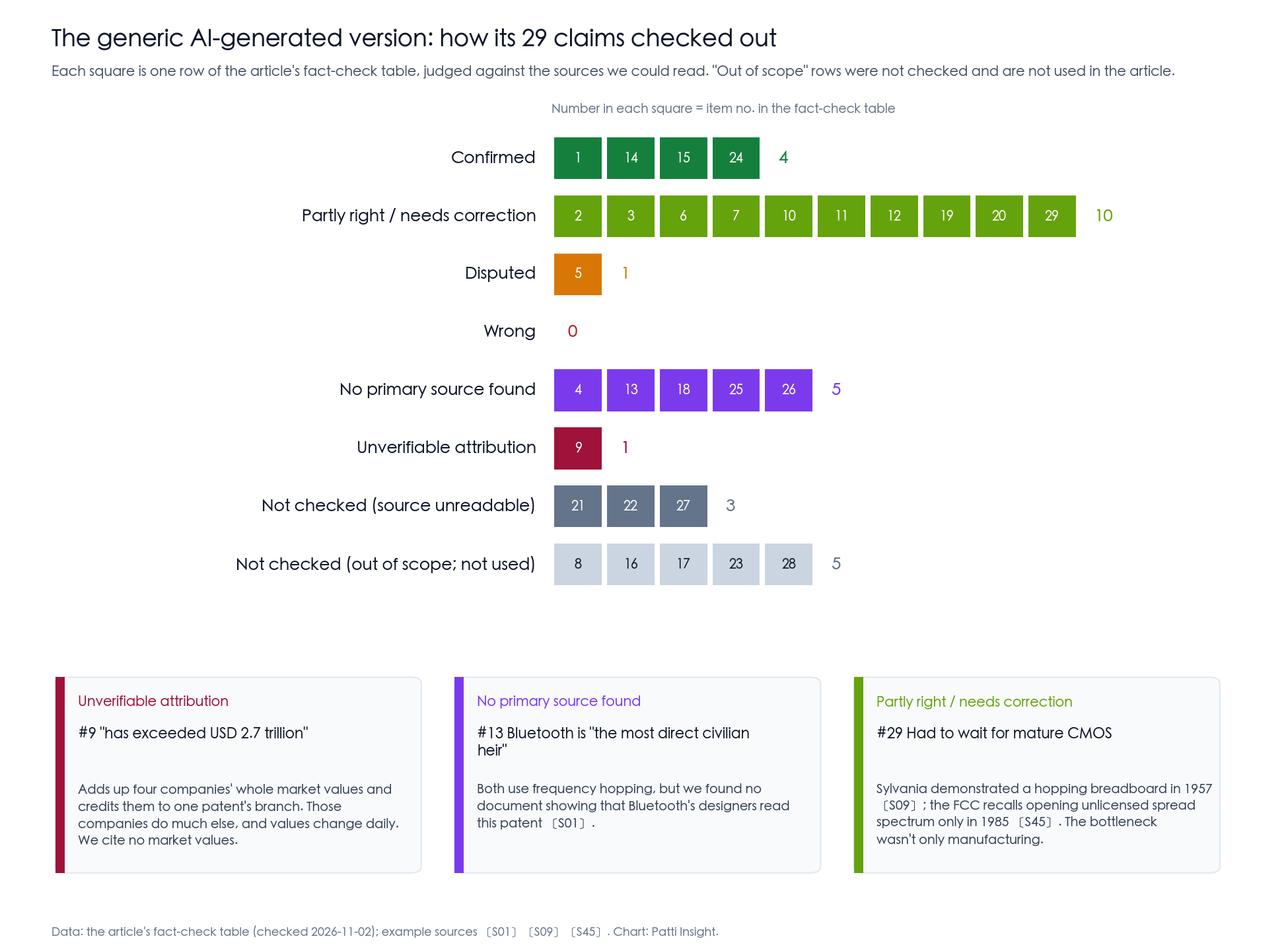
Figure: The 29 rows of the fact-check table, grouped by verdict. Confirmed 4; partly right or needing correction 10; disputed 1; wrong 0; no primary source found 5; unverifiable attribution 1; not checked because the source could not be read 3; a further 5 are out of scope, unchecked and not in the text. Sources for the three examples: 〔S01〕〔S09〕〔S45〕.
Act 2 — How someone back then would have asked
Set the clock to August 1942. Imagine you run engineering at a mid-sized American radio-parts maker that builds precision motors and variable capacitors. The war is on, and your CEO asks: should we get into secret radio?
Most people would ask it like this:
The typical question: "What are the development trends in secret radio communication?"
That gets you an encyclopedia entry: which methods exist, how each works, which looks promising. You still don't know whether to invest.
If Patti had been available in 1942, it would first restate your question back to you, and ask it like this instead:
The question after Patti's restatement: "We make precision motors and variable capacitors in the U.S. (say where you sit). We need to decide whether to commit to parts for rapidly retuning transceivers over the next five years (say what decision you're making). For radio that fears jamming and false signals, what are the routes, and what limit is each stuck on (ask about the bottleneck, not the trend)? What signals would show that one route is starting to win (ask for signposts, not predictions)? Use only information public by August 11, 1942."
(Illustration. The actual restatement screen keeps your original question word for word, then lists the aspects Patti suggests adding for you to tick.)
Four things change: where you sit, the decision, the bottleneck, the signposts. A motor and capacitor maker cares about one thing: which route needs what I make, and when does that route clear its hurdle?
If Patti had existed back then ①: ask differently, get a different report
The typical question Asked the Patti way What it asks about Trends Bottlenecks and signposts The report you get An encyclopedia entry: methods, how each works, which looks promising A signpost table: where each route is stuck, and which signals mean it is starting to win What you can do after reading Still not sure whether to invest Know which signals to watch, and move when you see them For you, the parts maker Communications theory that has nothing to do with you Which route needs what you make Act 3 is the report you get when you ask the Patti way.
Act 3 — The 1942 Patti report (data cutoff: August 11, 1942)
The following was rebuilt by hand by us along these lines; it is not output from a real Patti run. The data keeps to the cutoff, but which documents we picked and which signposts we set are shaped by hindsight.
Everything below uses only patents public by August 11, 1942. A patent's "issue" date is when the office made it public; its "filing" date is when it was submitted. A one-page version appears as the figure at the end of this act.
The problem. The fear in radio remote control is that an enemy can quickly find the control frequency and then block control by sending false signals on it. That is the problem stated by a U.S. patent issued in August 1942 〔S01〕.
The bottleneck. To stay secret and resist interference, you can't sit on one frequency. Tesla's patents issued in 1903 already sent two or more frequencies at once or in rapid succession, explicitly for privacy and against interference 〔S02〕〔S03〕. Over the next forty years, public patents show three routes. Most run into one problem: how do sender and receiver stay in agreement while a third party can't keep up? (our generalization)
Route 1: Manual frequency changing. Broertjes's U.S. patent US 1,869,659, issued on August 2, 1932, uses a group of frequencies known only to sender and receiver, alternated during transmission; according to the summary we read, both sides stay in agreement through identical manual operations 〔S06〕. The price of this route is that it depends on human operators. - Signpost ① (set by us): A public patent or product that changes frequency continuously and automatically, with no operator; three years.
Route 2: Prerecorded, synchronized frequency changing. This is her patent: US 2,292,387, "Secret communication system," filed on June 10, 1941 and issued on August 11, 1942. It is signed with her legal name, Hedy Kiesler Markey, not her stage name Lamarr, along with George Antheil 〔S01〕〔S14〕. Its stated use is the remote control of craft such as torpedoes 〔S01〕. The heart of Claim 1 (a claim is what the applicant asks to protect): each end has a record strip whose recordings determine the carrier frequency, and the two strips move in synchronism so the receiver stays tuned to the transmitter 〔S01〕. Synchronization may use accurately calibrated constant-speed spring motors; when the torpedo is fired, the connecting conductors break 〔S01〕. The 88 frequencies the patent mentions are only an example: a conventional player-piano record may have 88 rows of perforations, which would permit 88 carrier frequencies; the embodiment controls seven switches 〔S01〕. The price of this route is the mechanism: paper rolls and motors have to fit inside a torpedo and stay in step to the end (our judgment). - Signpost ② (set by us): A public demonstration of synchronized frequency changing without paper rolls; ten years.
Route 3: Other ways of varying or masking the signal. These three have different aims; grouping them is for narrative convenience. Chaffee and Purington's US 1,690,719 (issued 1928) mechanically varies the frequency in a periodic way, for secrecy 〔S04〕. Goldsmith's US 1,761,118 (issued 1930) radiates over a range of frequencies, to avoid fading 〔S05〕. Telefunken's Kotowski and Dannehl, US 2,211,132 (issued 1940), cover speech with noise, with synchronized rotating disks producing the same noise at both ends 〔S07〕. The price of this last one is at the receiver: the better the masking, the more the receiver depends on synchronization (our judgment). - Signpost ③ (set by us): A public demonstration of communication under deliberate interference; ten years.
What it means for you. The Route 2 patent describes constant-speed spring motors and tuning condensers (capacitors) 〔S01〕; whether your products fit needs a separate evaluation. If frequency changing stops relying on paper and springs, constant-speed motors may stop mattering, while tuning condensers may still be needed (our judgment on these last two sentences). Where you sit decides which signpost you should be watching.
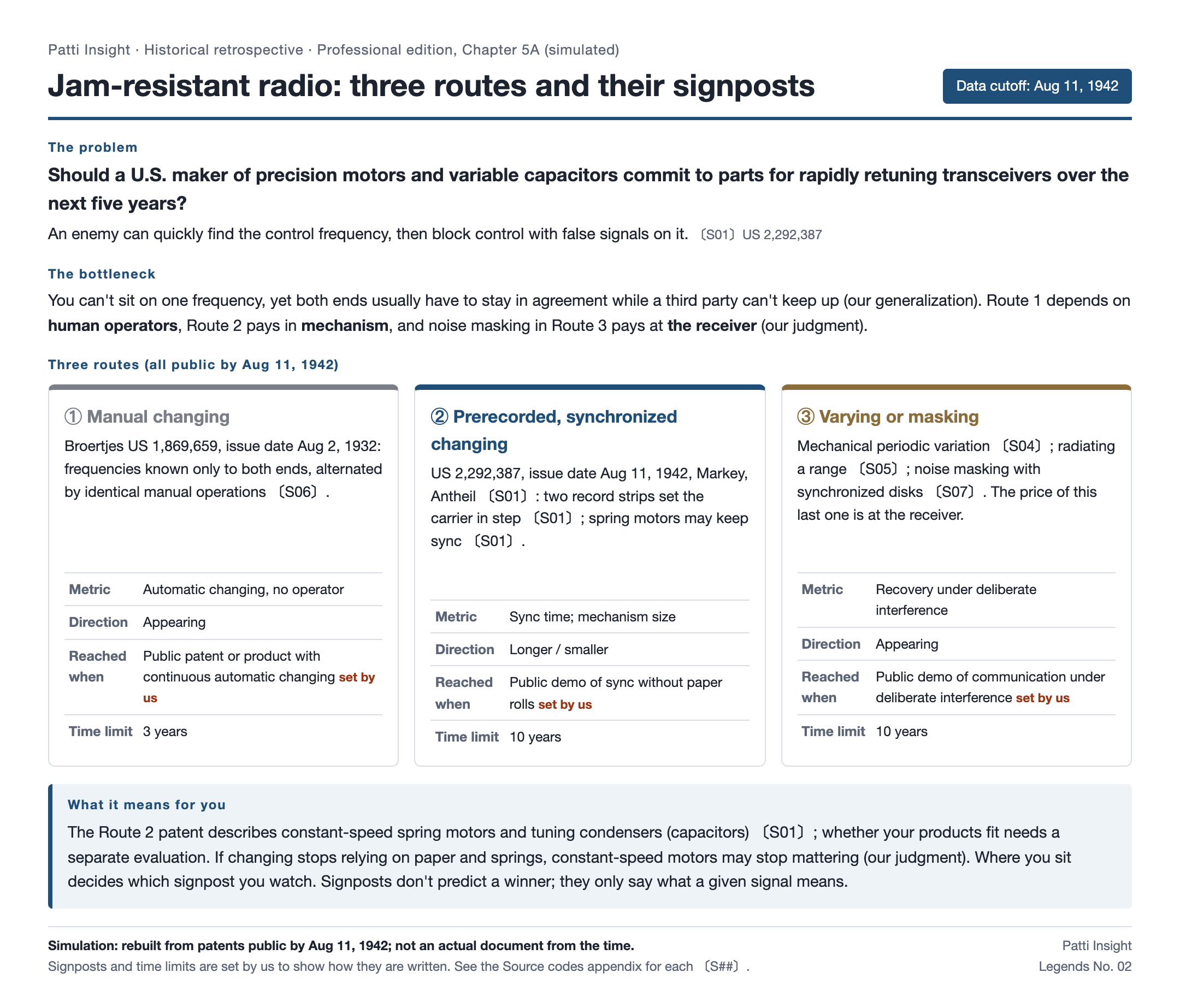
Figure: The one-page version of Act 3, rebuilt only from patents public by August 11, 1942 〔S01〕〔S04〕〔S05〕〔S06〕〔S07〕. It is a simulation, not an actual document from the time; signposts and time limits are our own.
If Patti had existed back then ②: within five years, which signposts get reached?
In August 1942, these three signposts are what you hold (the one-page version is above), and your decision covers the next five years. How many get reached? And is anything missing from them? Think it over, then read Act 4.
Act 4 — The reveal (hindsight)
Everything in this section was learned after the fact. A 1942 reader couldn't see it.
How did the three signposts do? Your decision runs to 1947. By then only signpost ① counts as reached, and only because we wrote it too loosely. On the public information we found, we saw nothing reliable in those five years to support investing right away (whether the 1945 test was public is unchecked; see the table below), so we would advise: don't set up a new production line yet; keep watching (our judgment).
| Signpost (set by us) | Time limit | What we read | Result |
|---|---|---|---|
| ① Automatic changing with no operator (public) | 1945 | Her patent changes frequency by paper roll and qualifies on its issue date 〔S01〕; but in wartime communications, hopping was still carried out by radio operators 〔S09〕 | Met on paper from the start: we wrote this signpost too loosely |
| ② Synchronized changing without paper rolls (public demonstration) | 1952 | The earliest we read of is the 1957 breadboard, shown to military communications users 〔S09〕 | Not seen |
| ③ Communication under deliberate interference (public demonstration) | 1952 | We found no qualifying public demonstration; ITT's printer communication system was tested in 1945 and performed well against an AM station 11 dB stronger than the signal; we did not check whether the test was public 〔S09〕 | Not seen; 1945 test's public status unchecked |
We set these signposts after the fact; this only shows how such a table is written and doesn't prove the decision right. A signpost not reached doesn't mean the direction is dead. Next: who actually built frequency hopping.
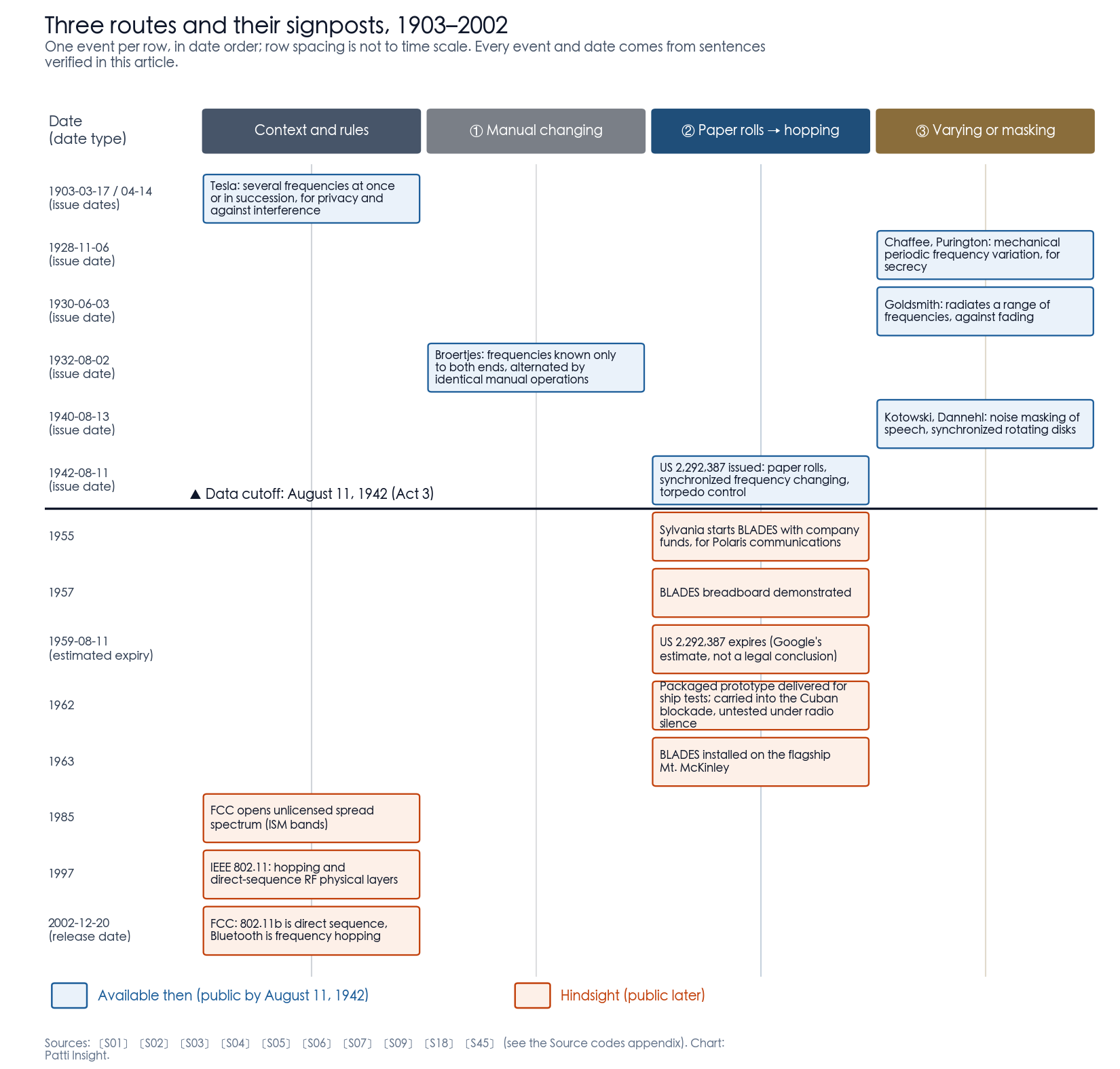
Figure: Key events on the three routes and in regulation, in date order; row spacing is not to time scale. Blue boxes were public by August 11, 1942 and readable at the time; orange boxes are hindsight. The bracket after each date gives its type; where the original source does not say, we leave it off 〔S01〕〔S02〕〔S03〕〔S04〕〔S05〕〔S06〕〔S07〕〔S09〕〔S18〕〔S45〕.
The Navy's verdict. The three secondary sources we read that give the Navy's reason all say the Navy found the mechanism too bulky to use in a torpedo, and APS News adds that it was unreliable; we did not read the Navy's original documents 〔S12〕〔S13〕〔S14〕〔S36〕. Antheil's own version is sharper: he believed the reviewers "read no further than the words 'player piano.'" 〔S13〕 (a self-playing piano). Act 3 (which we wrote after the fact) places the bottleneck on synchronization, and Scholtz's record agrees: during the war, frequency hopping was a recognized anti-jamming concept, but communication hopping was carried out by radio operators precisely because an accurate synchronous frequency reference at the receiver was so hard to provide 〔S09〕. He sums up the barriers of the time as "as much technological as they were conceptual" 〔S09〕.
In the 1950s, Sylvania built a separate frequency-hopping system. Its engineer Nicholson did frequency synthesis with a tapped delay line; Scholtz writes that even though patent searches uncovered similar claims by the Hammond Organ Company, it was a breakthrough for Sylvania's engineers working on spread spectrum 〔S09〕. This frequency-synthesis device was also an essential part of BLADES, Sylvania's frequency-hopping communication system 〔S09〕. BLADES began with company funds in 1955, originally for Polaris submarine communications 〔S09〕; a breadboard system was demonstrated in 1957 〔S09〕. In 1962 a packaged prototype was delivered for shipboard testing and carried into the Cuban blockade, but not tested there because of a radio silence order 〔S09〕. Wikipedia instead says "the US Navy utilized Sylvania Electronic Systems Division's work during the Cuban Missile Crisis" 〔S11〕; the two differ, and we follow Scholtz. In 1963 BLADES was installed on the command flagship Mt. McKinley, quite likely the earliest frequency-hopping communication system to reach an operational state, in Scholtz's judgment 〔S09〕.
Is that connected to her patent? We can't find evidence, and we can't rule it out. Her patent expired on August 11, 1959 (Google Patents' estimate) 〔S01〕. An OCR full-text search of Scholtz's long paper found neither this patent nor her name, but a lead (seen only in a search excerpt) says he left that thread for Price to write 〔S09〕〔S23〕, so "not mentioned" can't be read as "not important." There was also another road: direct-sequence spread spectrum. Scholtz says its motivation appears to have come from time-of-arrival measurement in navigation systems, and that it came several years after frequency hopping 〔S09〕.
Two things the signposts left out. The signposts in Act 3 are entirely technical. Secrecy and regulation also affected this road; the effect of secrecy is our judgment, while on regulation the FCC says so itself.
First, secrecy. The synchronization-tracking invention for Sylvania's direct-sequence system Hush-Up (later the ARC-50) was under patent secrecy order until shortly before Scholtz wrote 〔S09〕. As of 1982, apparently no unclassified description of BLADES was available, with only glimpses in a few "sanitized" papers and patents (sensitive details removed) 〔S09〕. Public leads came late: a patent by Purington, issued in 1953, came close to describing a time-hopping (spreading a signal by sending narrow pulses at random intervals) and frequency-hopping carrier, though its actual details describe a time-hopping system 〔S09〕. By then the time limits in Act 3 had passed.
Second, regulation. The FCC opened an inquiry on June 30, 1981 and adopted its order on May 9, 1985. The order opens by saying spread spectrum was originally developed for military applications and "has been implicitly forbidden by the FCC rules with a few limited exceptions"; the new rules let it operate in the Industrial, Scientific and Medical (ISM) bands at 902–928, 2400–2483.5 and 5725–5850 MHz on a noninterference basis, limited to 1 watt 〔S25〕. Replies to the 1981 inquiry broadly favored introducing it; but until more experience had accumulated, a majority were firmly against a general overlay of spread spectrum on the bands existing services already use, while few objected to low-power, limited-range uses 〔S25〕. Looking back in 2002, the FCC called the 1985 opening the first significant change, with no limits on the type of application as long as devices met the technical requirements 〔S45〕. Next, IEEE 802.11, approved in 1997, has two radio-frequency physical layers, frequency hopping and direct sequence, and the committee's document says both were designed to meet FCC Part 15.247 and ETSI 300 328 〔S18〕. The same 2002 FCC document says standards such as 802.11b and Bluetooth had greatly expanded the devices in the 2.4 GHz ISM band; 802.11b is direct sequence and Bluetooth is frequency hopping 〔S45〕.
What did she get? On income, we found no record. Honors came very late: the Electronic Frontier Foundation's Pioneer Award, dated 1997 by Wikipedia from a press release and 1998 by the American Physical Society; and a posthumous induction into the U.S. National Inventors Hall of Fame in 2014; we read these only in general media 〔S12〕〔S14〕.
What we could not check. We did not read the Navy's original documents 〔S36〕, Price's 1983 full text 〔S22〕, the oral history of Irwin Jacobs (a co-inventor of Qualcomm's US 4,901,307 〔S08〕) or Qualcomm's company history 〔S42〕, the Bluetooth, 802.11b or 3G specifications, EFF's or the Hall of Fame's originals, or Antheil's memoir and her biography, and we did not check the CMOS timeline. If we could read these, some judgments above might change.
Looking back at Act 3: These signposts at least force you to tie the decision to signals, and the bottleneck placed on synchronization matches the later record. Their faults are just as clear: one signpost was too loose, and they did not list secrecy or regulation at all. We don't claim anyone would have thought of them then. This is also what we most want to leave you with: a signpost table only tells you about what you thought to watch. So ask one more question: apart from the technology, who else can decide whether this road opens?
If you had Patti today ③: does a winning route keep winning?
Act 4 looks like an ending: frequency hopping went into Bluetooth, direct sequence into 802.11b. But a signpost only says where a route is stuck, not that things stay that way. What happened next?
Interlude — What happened next (hindsight)
Everything in this section is hindsight.
In 1997, the two routes sat side by side. IEEE 802.11 included both frequency hopping and direct sequence 〔S18〕.
In 2002, an FCC document listed the two separately. 802.11b took direct sequence and Bluetooth took frequency hopping 〔S45〕. Bluetooth usually hops 1,600 times per second across 79 channels (we read this figure only in general media, not in the specification) 〔S21〕.
With cellular LTE and 5G NR, the main waveforms moved to the OFDM family. The phrase "spread spectrum" appears nowhere in either physical-layer specification, though the absence of the phrase doesn't mean no spreading sequences are used at all. The words "frequency hopping" haven't gone away either: both specifications still have a frequency-hopping option. It changes frequency at the resource-block level, for a different purpose than blocking false signals (our judgment) 〔S19〕〔S20〕.
For engineers today: these three moments describe technical choices, not who made money. The same function takes different forms in different eras. What matters isn't which route you stand on. It's reading the signposts, and knowing a signpost table may have left something out.
If she had had Patti in 1941 ④: where does this function turn up later?
When she filed US 2,292,387, she could not see where this function would go; the patent-classification chart in Act 5 can only be drawn after the fact. When you've seen it, ask yourself: where will the function in your patent turn up later?
Act 5 — Descendants?
Here is the core function of this patent, written as one general sentence:
On a rhythm agreed in advance by sender and receiver, keep changing where the transmission sits, so anyone outside the agreement can neither keep up nor block it.
That function does turn up later, in Bluetooth, 802.11 and elsewhere. Whether those things descend from this patent is another matter. This patent's citation data can be read, but it isn't enough to draw a straight line.
What the citation data says. In Google Patents data, this patent is cited by 152 documents in 83 patent families (a family groups one invention's filings across countries) 〔S46〕. The earliest three are RCA's secrecy facsimile (issued 1955), Northrop's radio remote control (issued 1957) and GEC's receivers (issued 1961), all labeled in the data as search-report citations 〔S46〕. Then, between 1961 and 1992, this dataset shows no citations at all (the data may be incomplete) 〔S46〕. Citations labeled as coming from the applicant first appear in patents issued in 2001, and 107 of the 152 fall into this category; that year may reflect when the labeling began, so it can't be read as "people only remembered her in 2001" 〔S46〕. Only 15 of the 152 carry a frequency-hopping classification 〔S46〕. A citation is not a lineage: in this data most were listed by applicants themselves, which shows their filing mentions it, not that they built on it (our judgment).
What the classification data says. Patent offices tag each patent with technical classes. The patent's own classification isn't even frequency hopping: it is filed under mechanical encryption (H04L9/38), synchronization of encryption devices (H04L9/12) and wireless (H04L2209/80). The earliest family in the frequency-hopping class (H04B1/713 and related) has a 1962 priority date; there are none before 1950 〔S46〕. The chart below lays out the related technologies decade by decade by patent classification (CPC).
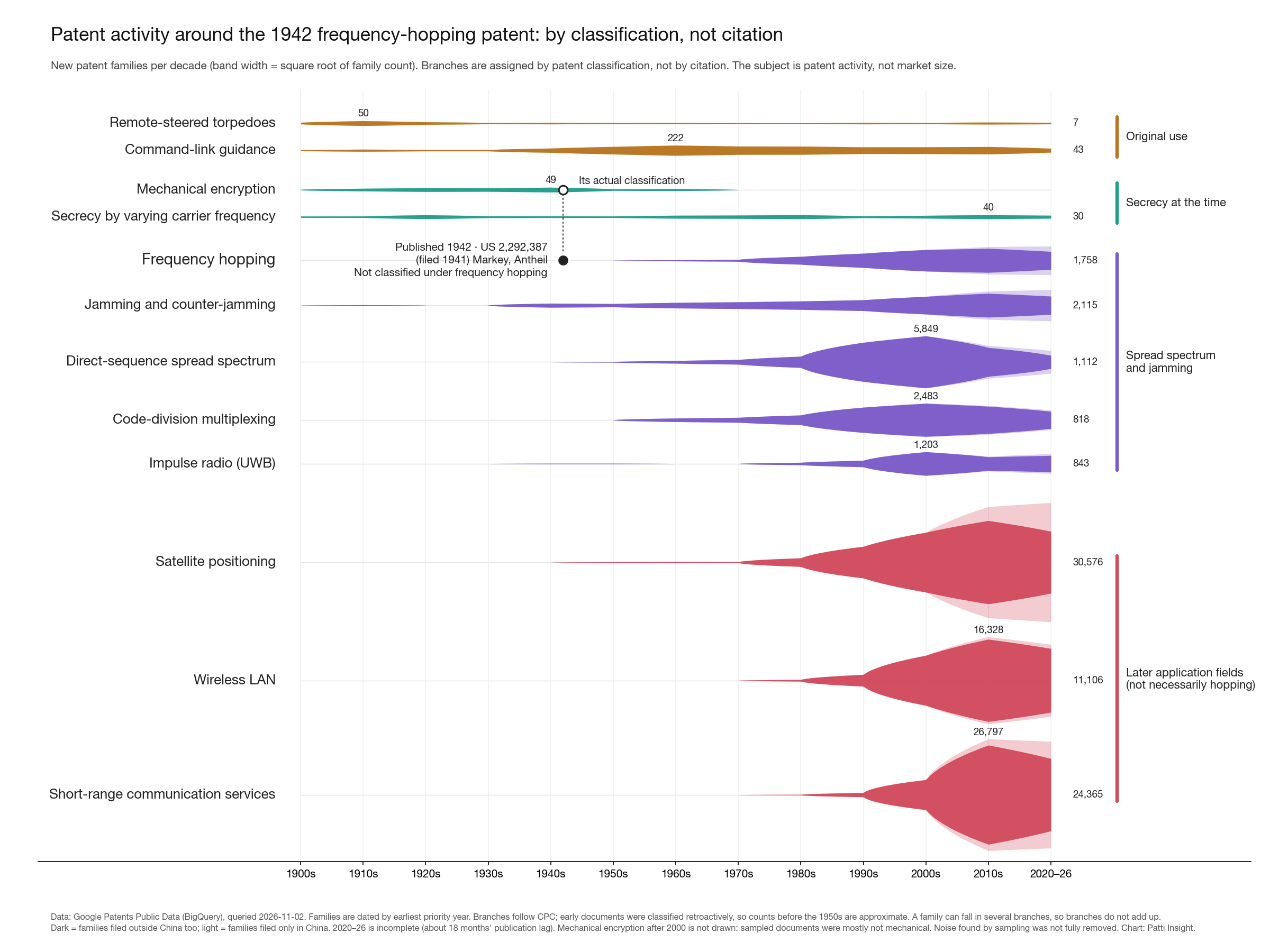
Figure: New patent families per decade; band width is the square root of the family count, binned by each family's earliest priority date 〔S46〕. Branches are assigned by patent classification — not by citation, and they are not descendants of this patent; that is why no trunk lines are drawn. The subject is patent activity, not market size. A family can belong to several branches, so branches can't be added up. Classifications on early documents were added retroactively, so decades before the 1950s are approximate; filings from 2020–26 are not yet fully published and cover only seven years, so they can't be compared directly with earlier decades. In our machine count of sampled titles, only about 28–43% per decade in the frequency-hopping branch mention hopping; the rest don't reveal it, so the branch shouldn't be read as patents solely about hopping. Not all noise has been removed.
Branch by branch.
- The original use. Remote steering of torpedoes (F42B19/10) peaked in the 1910s with 50 families and has only 7 in 2020–26. Command-link guidance peaked in the 1960s with 222 〔S46〕. Compared with the 1910s, the torpedo branch has not gained families (2020–26 covers only seven years).
- The frequency-hopping class. 134 families in the 1980s; 1,614 in the 2010s (1,241 excluding China-only filings); 1,758 in 2020–26 (688 excluding them) 〔S46〕. Of the 1,758 in 2020–26, 1,070 were filed only in China, so this branch can't be read as a global trend.
- Direct sequence and code division. Direct sequence had 5,849 families in the 2000s and has 1,112 in 2020–26. Code-division multiplexing had 2,483 in the 2000s 〔S46〕.
- Later application fields. Satellite positioning has 30,576 families in 2020–26 (22,347 only in China); wireless LAN had 16,328 in the 2010s; short-range communication services had 26,797 in the 2010s 〔S46〕. These are far larger than the frequency-hopping class, but they don't necessarily use it. They share the chart to show scale, not to say they all came from this patent.
The market layer: left blank in this article. We looked for figures on Bluetooth, Wi-Fi and mobile subscriptions, but what we could read mostly comes from research firms, or carries terms restricting reproduction, or has licensing we haven't yet confirmed, so we leave them out for now 〔S47〕. That doesn't mean there is no market: this article leaves blank how big the market is for each branch on the chart. Patent family counts show that people are placing bets, not how big the market is.
That USD 2.7 trillion can't be credited to Lamarr or to any single patent. Industries grow from decades of work by many people, and this one also has to do with the FCC's rule changes in the 1980s. Patti answers "where does this function reach?" — not "whose money is this?"
Closing: if you have a technical question of your own
The approach shown in this article can be reused: what could be seen at the time, what should have been asked, and which signposts were worth watching.
If you want Patti Insight to look at your own topic, there are two routes. Ready-made reports are on topics we chose, and you can buy them directly. A tailored study starts with an application: a person reviews your identity and topic first, we send a payment link only if the application is accepted, and research starts after payment. A topic may be declined, and a report may not answer everything you wanted to know. Where Patti hasn't read the full text, it won't judge whether a technical gap (something no one has solved yet) exists there.
This article did not look into which branch your technology falls in, or how that branch is doing.
How Patti Insight works, and its limits: https://patti.empryon.ai/methods
Act 3 of this article is a simulation: rebuilt by hand by us from patents public by August 11, 1942, not an actual document from the time and not output from a real Patti run. All signpost thresholds were set by us to illustrate the method.
Ready-made reports
This article is a retrospective. For current technical questions, see the ready-made Patti Insight reports.
Source codes
Each code 〔S##〕 in the text corresponds to a line below. Every code used in this article is listed.
- 〔S01〕Hedy Kiesler Markey, George Antheil | "Secret communication system," US 2,292,387 | https://patents.google.com/patent/US2292387A/en | Primary source (patent full text)
- 〔S02〕Nikola Tesla | "Method of signaling," US 723,188 | https://patents.google.com/patent/US723188 | Primary source
- 〔S03〕Nikola Tesla | "System of signaling," US 725,605 | https://patents.google.com/patent/US725605 | Primary source
- 〔S04〕Chaffee, Purington | "Method and means for secret radiosignaling," US 1,690,719 | https://patents.google.com/patent/US1690719 | Primary source
- 〔S05〕Alfred N. Goldsmith | "Radio signaling system," US 1,761,118 | https://patents.google.com/patent/US1761118 | Primary source
- 〔S06〕Willem Broertjes | "Method of maintaining secrecy in the transmission of wireless telegraphic messages," US 1,869,659 | https://patents.google.com/patent/US1869659 | Primary source
- 〔S07〕Paul Kotowski, Kurt Dannehl (Telefunken) | "Method of transmitting secret messages," US 2,211,132 | https://patents.google.com/patent/US2211132 | Primary source
- 〔S08〕Gilhousen, Jacobs, Weaver (Qualcomm) | "Spread spectrum multiple access communication system using satellite or terrestrial repeaters," US 4,901,307 | https://patents.google.com/patent/US4901307 | Primary source (only part of the page read)
- 〔S09〕Robert A. Scholtz | "The Origins of Spread-Spectrum Communications" | IEEE Trans. Commun. COM-30(5):822–854, 1982 | https://minghsiehece.usc.edu/wp-content/uploads/2017/11/Origins-of-Spread-Spectrum-Communications.pdf | Scholarly secondary source
- 〔S10〕Robert Price | "Further Notes and Anecdotes on Spread-Spectrum Origins" | IEEE Trans. Commun. 31(1):85–97, 1983, DOI 10.1109/TCOM.1983.1095725 | Scholarly secondary source (abstract only)
- 〔S11〕Wikipedia | Frequency-hopping spread spectrum | Read November 2, 2026 | https://en.wikipedia.org/wiki/Frequency-hopping_spread_spectrum | General media
- 〔S12〕APS News | This Month in Physics History, June 2011 | https://www.aps.org/apsnews/2011/06/this-month-in-physics-history | General media (society publication)
- 〔S13〕Hans-Joachim Braun | "Hedy Lamarr, Radio-Controlled Torpedo" | Invention & Technology | https://www.inventionandtech.com/node/87082 | General media (specialist publication)
- 〔S14〕Wikipedia | Hedy Lamarr | Read November 2, 2026 | https://en.wikipedia.org/wiki/Hedy_Lamarr | General media
- 〔S16〕Andrew Viterbi oral history | ETHW (IEEE History Center) | https://ethw.org/Oral-History:Andrew_Viterbi | Primary source (participant's account)
- 〔S18〕Dean Kawaguchi | "802.11 Summary for FCC Teleconference," IEEE P802.11-97/97, September 19, 1997 | https://www.ieee802.org/11/Documents/DocumentArchives/1997_docs/70973.pdf | Primary source (standards-committee document)
- 〔S19〕ETSI TS 136 211 V15.2.0 (3GPP TS 36.211, LTE physical layer) | https://www.etsi.org/deliver/etsi_ts/136200_136299/136211/15.02.00_60/ts_136211v150200p.pdf | Primary source
- 〔S20〕ETSI TS 138 211 V15.2.0 (3GPP TS 38.211, 5G NR physical layer) | https://www.etsi.org/deliver/etsi_ts/138200_138299/138211/15.02.00_60/ts_138211v150200p.pdf | Primary source
- 〔S21〕Wikipedia | Bluetooth | Read November 2, 2026 | https://en.wikipedia.org/wiki/Bluetooth | General media (specification not checked)
- 〔S22〕Robert Price 1983, full text | Not checked: full text not obtained; only the abstract in 〔S10〕 was read.
- 〔S23〕Robert A. Scholtz short essay (USC web page) | https://minghsiehece.usc.edu/?p=9152 | Not checked: page unreadable; seen only in a search excerpt.
- 〔S25〕Federal Communications Commission | Authorization of Spread Spectrum Systems Under Parts 15 and 90, Gen. Docket 81-413, FCC 85-245 | 50 Fed. Reg. 25234 (June 18, 1985) | https://www.govinfo.gov/content/pkg/FR-1985-06-18/pdf/FR-1985-06-18.pdf | Primary source
- 〔S36〕U.S. Navy and National Inventors Council original files | Not checked: not found.
- 〔S42〕Irwin Jacobs oral history; Qualcomm company history | Not checked: not read.
- 〔S45〕Federal Communications Commission | Notice of Inquiry, ET Docket No. 02-380 (FCC 02-328), released December 20, 2002 | https://docs.fcc.gov/public/attachments/fcc-02-328a1.pdf | Primary source (FCC document)
- 〔S46〕Google Patents Public Data (BigQuery public dataset
patents-public-data.patents.publications) | Queried November 2, 2026 | Primary source (patent bibliographic dataset) - 〔S47〕Market-data check record for this article | November 2, 2026 | Figures and terms on public pages of the Bluetooth SIG Market Update, Wi-Fi Alliance, World Bank/ITU, EUSPA and others; the figures are not cited here, and the record is available from the publisher on request.