If Patti Had Existed Back Then: The Patent IBM First Rated Not to File. What Did It Actually Protect?
A Patti Insight Legends article. We take a piece of technology history and ask: what could people see at the time, what should they have asked, and which signposts (signals that a path is starting to work) should they have watched? Each section is marked clearly: what was visible at the time, and what is hindsight.
Each 〔S##〕 in the text corresponds to the source list at the end; a verification record for the main factual statements is available from the publisher on request.
IBM researcher Hiroshi Ito wrote a patent disclosure on a type of chemically amplified resist (a resist is the light-sensitive material used to form images in chip making; chemical amplification is explained below), and it came back rated not to file: publish it in the IBM Technical Disclosure Bulletin instead. He recalled that the invention was seen as "an interesting laboratory curiosity." He kept generating higher-quality images, appealed, and finally got an application filed 〔S20〕.
That application, filed in August 1982, became US 4,491,628 (hereafter '628). Ito later called this resist (tBOC, a kind of tertiary-butyl, or t-butyl, carbonate) the "foundation" of advanced resist systems 〔S20〕.
The idea: light generates a little acid, and the acid acts as a catalyst, cutting groups off a polymer 〔S20〕 without being consumed (as a later IBM patent explains) 〔S06〕. When the groups come off, polarity changes, and so does solubility in the developer 〔S01〕. This is chemical amplification: one photon can drive many chemical reactions. A 2013 University of Texas engineering school news release says many adaptations of this resist were developed and that these commercial materials are used throughout the industry 〔S31〕.
So what did this patent protect?
On the wording of claim 1 (the claims state what a patent actually asserts), it claims two t-butyl classes of material, not the idea of chemical amplification (this is not a legal judgment). We found three things.
First, it was narrower than the idea, yet on its face it covered the negative tBOC that IBM produced (negative: the exposed areas stay). Claim 1 limits the acid-sensitive groups to "tertiary butyl esters of carboxylic acids or tertiary butyl carbonates of phenols" 〔S01〕. The same specification says "a wide range of acid labile groups are operative" and names trityl and benzyl 〔S01〕. Science historian David Brock writes that the patent was "limited to just the tBOC material, not the very idea of a CA photoresist" 〔S30〕. He is right that the idea was not captured. But claim 1 holds more than tBOC: it also has t-butyl carboxylic esters. The negative tBOC resist IBM produced appears on its face to fall within claim 1 〔S01〕〔S20〕; ESCAP, the positive resist IBM developed later (positive: the exposed areas dissolve), was used at 248 nm, a deep-UV wavelength 〔S30〕 that industry later produced with KrF excimer lasers 〔S43〕; its t-butyl acrylate on its face falls under t-butyl carboxylic esters, though we have no document on ESCAP's relationship to '628 〔S20〕. All of this is a reading of the words, not a legal judgment.
Second, Brock writes that IBM guarded the material and air filtering (cleaning contaminants out of the air so the resist stays stable) through secrecy, but no document weighs secrecy against the patent. IBM kept the resist as a proprietary material and filtered air as a "closely held trade secret" into the early 1990s 〔S30〕. This rests mainly on one history built largely on IBM-side interviews; we did not find a second independent document to confirm it.
Third, patents were licensed, but we do not know whether '628 was among them. The University of Texas release says "The patents were licensed in the early 1990s" without saying which 〔S31〕; Ito writes that the ESCAP technology was "licensed by all major resist companies" 〔S20〕. We read nothing on amounts, terms or licensees. So how much the patent mattered cannot be determined from the documents we read.
Brock wrote about the narrow patent and the secrecy in 2007, so we are not the first to take this angle. What we add is the claim language laid out word for word, which turns out to cover more than "just tBOC," and a return to 1985 to see what people then could actually read.
Act 1: Take the patent away. Would anything change?
This table is the core of the article. "Change" here means who could sell and who paid whom. We ask the question event by event.
| Event | What the documents say | Take the patent away: different? |
|---|---|---|
| IBM's in-house production (1986) | IBM used its own resist, kept air filtering secret, and made several million 1 Mbit DRAMs 〔S30〕; negative tBOC on its face within claim 1 〔S01〕〔S20〕 | Cannot tell: no document discusses the patent and the production decision together |
| The air-filtering fix | A trade secret 〔S30〕; the full text of '628 has no air filtering, and it was filed in 1982 〔S01〕 | Not applicable: this step is not in '628; we did not check IBM's other patents |
| Rivals' deep-UV resists (early 1990s) | Brock writes rivals brought their own versions to market "by the early 1990s," citing the narrow patent and prior art 〔S30〕; Shipley published in 1993 〔S26〕 | Cannot tell: the documents do not say which groups they used or whether they paid for licenses |
| IBM licensing (1990s) | Patents licensed, unnamed 〔S31〕; ESCAP technology licensed to major resist makers 〔S20〕 | Yes: the University of Texas release says patents were licensed; on ESCAP, Ito writes only "technology" and names no licensor; whether '628 was included is unknown, as is scale |
| IBM's active transfer (mid-1990s) | As IBM relied more on outside tools, toolmakers and their customers needed access to the resists 〔S30〕 | Cannot tell: the reason Brock gives is not the patent |
| Japanese resist makers rise | In 1984 Tokyo Ohka already held 78% of Japan's domestic negative and 50% of its positive market 〔S45〕, before chemically amplified resists were commercial; Asano's 2009 paper also writes that each generational change gave later entrants an opening, chemically amplified resists being the third generation 〔S45〕 | Cannot tell: the paper explains the rise by materials know-how, joint development and competition (we spot-checked it, not a full read) |
| The next generation, 193 nm | Fujitsu licensed its basic patent to several resist makers (as reported in a paper) 〔S45〕; Lucent also holds patents 〔S08〕 | Yes: Fujitsu licensed; whether it charged, and whether IBM or Lucent licensed, the documents do not say |
License terms and private negotiations are not visible, so this table can only ask about the public part. Was there litigation? We saw no lawsuit over '628 in general search and did not check court databases; its European family member (the same invention's European filing) drew no opposition 〔S02〕. Separately, we found one case: Rohm and Haas against JSR, settled in 2005, over a solvent 〔S55〕.
25 statements we drew up ourselves. These are possible statements we thought of; they do not mean anyone actually asserts them. Checked one by one: 3 confirmed, 11 partly right or needing correction, 2 disputed, 5 wrong, 3 with no primary source found, 1 an unverifiable attribution. We chose the items, so this is not a statistic. For example, "IBM's first generation used KrF excimer lasers": no, it used older mercury-lamp tools 〔S20〕〔S30〕. "IBM produced a positive resist": no, negative 〔S20〕. "IBM held a ten-year monopoly through the patent": no document attributes it that way 〔S30〕.
Act 2: How someone at the time would have asked
Go back to the end of 1985. You are the technical lead at a mid-sized resist maker. Accounts differ on whether optical lithography is nearly finished. Your boss asks: where should we invest for the next resist?
"What are the trends in resist technology?" would likely get you little more than an encyclopedia-style overview. Patti would rework it into: I run technology at a mid-sized resist maker and must decide which path to fund for the next five years; where each path is stuck; which signals would change my decision; who holds the patents on this path, and whether I will run into them; using only material public by the end of 1985.
(Illustrative. In practice Patti first restates your question; that screen keeps your original question word for word, then lists suggested additional dimensions for you to tick.)
Act 3: The report as it could have been (data cutoff: end of 1985)
What follows was rebuilt by hand by the author from this question; it is not output from an actual Patti run. It uses only material public by the end of 1985; some facts come from later compilations, but the events themselves were public at the time. We did not read most journal and conference papers of the period in full, so we do not write "the industry believed at the time," only what public patents and titles let you read. The data respects the cutoff, but which documents we chose and which signposts we set are shaped by hindsight.
The problem. The mainstream was near-UV exposure 〔S10〕 with DNQ-novolac, a positive resist formulation that replaced the previous generation from the early 1980s (as recounted by a later paper) 〔S45〕. Tokyo Ohka announced OFPR-800 in 1979, and it was widely used for 64Kb DRAM 〔S41〕. In 1984 Tokyo Ohka held 78% of Japan's domestic negative and 50% of its positive market (a 1985 Yano Research estimate, as relayed by a later paper) 〔S45〕. A patent issued in 1982 says the best commercial tools reach 1.25 micrometers, and on production much finer than that, "Engineers are divided" (one individual applicant's account, not a consensus) 〔S10〕.
Path 1: Push near-UV and DNQ further. This path uses existing tools and sells to existing customers. The 1982 patent above (US 4,350,755) writes "the fundamental limit in resolution is twice the wavelength," with commercial tools at 4000 angstroms 〔S10〕.
- Signpost (ours): major memory makers still produce this way in 1990; five years.
Path 2: X-ray. Search results show both "The Time Has Come For X-Ray Lithography" and "X-Ray Lithography: Can It Be Justified?" as titles at the 1985 SPIE meeting 〔S71〕. We saw only the titles; where it is stuck would take the full text.
- Signpost (ours): a large memory maker announces production by X-ray; ten years.
Path 3: Deep UV with a new resist. US 4,350,755, the same patent, says quartz does not transmit below 2000 angstroms, calling that "the apparent ultimate limit for photolithography," so this path has a floor too 〔S10〕. IBM's '628 issued on January 1, 1985; its European and Japanese applications were already published on March 14, 1984 〔S01〕〔S02〕〔S03〕. From 1982 the inventors published under titles using "chemical amplification"; we saw only the citations and did not read the papers 〔S70〕〔S91〕. Whether anyone is in production cannot be told from the public documents we read.
- Signpost (ours): a fab says publicly that it produces memory with this class of resist; five years.
The patent layer. The idea did not start at IBM. 3M's US 3,779,778 (filed 1972, issued 1973) already speaks of compositions "capable of catalytic reactivity and therefore higher quanta efficiencies" and mentions acid-degradable linkages pendant to the backbone (the polymer's main chain); its wavelengths are 300 to 700 nanometers, not deep UV 〔S04〕. Hoechst's US 4,311,782 (priority 1979, issued 1982) uses photogenerated acid to cleave ester groups within the main chain 〔S05〕. IBM's claim 1 describes acid-sensitive groups pendant from the backbone, limits them to two t-butyl classes, and lets the developer decide positive or negative 〔S01〕. The specification says "a wide range," but claim 1 is not written that wide 〔S01〕.
- Signpost (ours): IBM starts licensing, or someone gets sued over it; ten years.
What it means for you. What the US claim 1 of '628 occupies is those two t-butyl classes, not the idea of photogenerated acid catalysis. Other acid-sensitive groups are worth evaluating, but this is only the wording of this one claim: we did not compare the claims of 3M or Hoechst, or the scope of the European and Japanese applications. Have counsel review it; this is not legal advice.
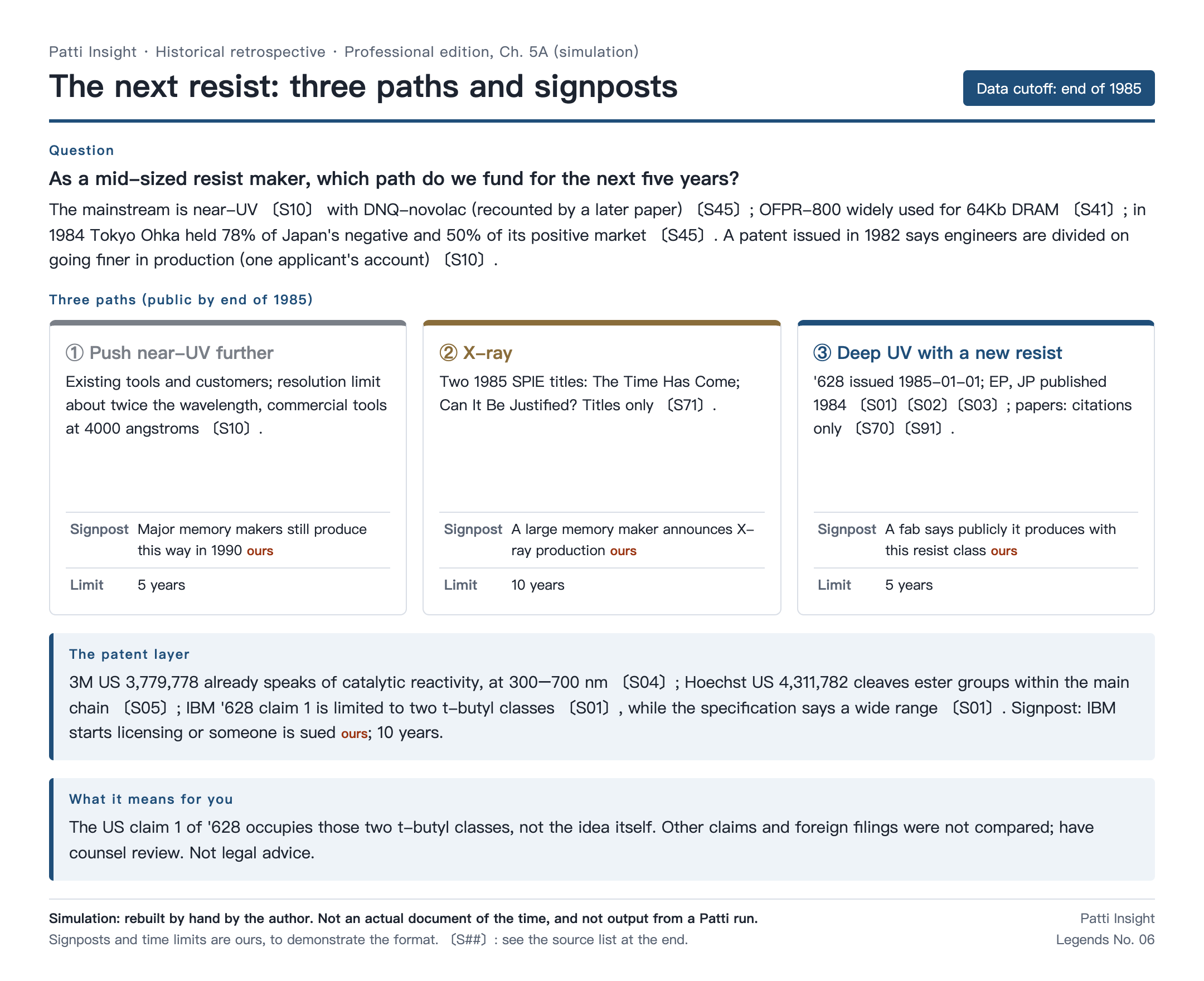
Figure: the one-page version of Act 3, rebuilt by hand by the author 〔S01〕〔S02〕〔S03〕〔S04〕〔S05〕〔S10〕〔S41〕〔S45〕〔S70〕〔S71〕〔S91〕. This is a simulation, not an actual document of the time; the signposts and time limits are ours.
If Patti had existed then: is this signpost list enough for your decision? Would seeing these four signposts change your decision? What did it miss? Think for a moment before reading on.
Act 4: The reveal (hindsight)
What follows was only known afterward, mostly from participants' accounts years later.
What the signpost list left out, we also did not find in the public documents of the time. At the end of 1985 you could read claim 1; that IBM had already staked its cutting-edge products on this resist, we did not find in any public document of the time. IBM's starting point was not the newest laser but saving money. IBM wanted to use its existing Perkin-Elmer tools in deep UV; the lamps were too dim, so it needed 30 times the sensitivity, and got 100 to 200 times 〔S30〕. Engineer John Maltabes had been evaluating replacing the mercury lamps with excimer lasers. After hearing the presentation by '628 co-inventor Willson he went back and urged his supervisors to kill his own project, and three months later they did 〔S30〕. The resist was so sensitive that the wafer stage could not keep up, so a neutral density filter went in to slow the exposure 〔S20〕.
What nearly sank it was the air. Maltabes recalls that over lunch, a researcher with disk-drive experience suggested the trouble might be "something in the air." That researcher and his colleagues had dealt with certain disk-drive failures using activated charcoal and HEPA filters, and surplus filtration units sat in a warehouse; he offered them to the tBOC team, and they went to IBM's Burlington site 〔S30〕. Ito writes that the filtering let IBM use negative tBOC to make 1 Mbit DRAM; by 1986 production was in full swing, several million chips in all 〔S20〕〔S30〕. Only later was it understood that under 10 ppb of airborne base could neutralize the acid at the resist surface 〔S20〕. Chemical amplification runs on a trace of acid, and that is also its price.
Filtering let the negative form go first; the positive had further to go. Developed in aqueous base, positive tBOC grew an insoluble surface layer and could not enter IBM manufacturing; Ito attributes this layer to the same airborne contamination 〔S20〕. That problem "almost killed the chemical amplification concept." Ito writes that they tried baking a wafer upside down and carrying a wafer boat to a nearby county park 〔S20〕. Ito writes that other proposed fixes for this contamination included a protective overcoat and a stabilizing base additive; he also writes of the positive materials APEX and ESCAP 〔S20〕.
One inventor said it should not have worked. Willson said "It shouldn't have worked": the catalyst should behave like a cow in a pasture, eating the whole field, blurring the lines 〔S31〕.
How did the signpost list do?
| Signpost (ours) | Deadline | What we read | Result |
|---|---|---|---|
| ① Major memory makers still produce with near-UV | 1990 | Ito: near-UV was still dominant in the rest of the industry at that time 〔S20〕; KrF reached practical industrial use only in the late 1990s 〔S43〕〔S45〕 | Broadly met (indirect) |
| ② A large memory maker announces X-ray production | 1995 | IBM was commissioning a synchrotron in 1991 〔S50〕; several companies were still discussing cooperation in 1994 〔S51〕; we read no production announcement | Not seen in what we read |
| ③ A fab says publicly it produces with this resist class | 1990 | A 1990 SPIE paper's title mentions 1-micron DRAM production, content unread 〔S27〕; the Willson group's 1980–89 lists show no title announcing fab production (a 1984 title mentions Semiconductor Manufacturing, on resist design, content unread) 〔S91〕 | In this list, first seen in 1990 |
| ④ IBM licenses, or someone is sued | 1995 | Licensed in the early 1990s 〔S31〕; no lawsuit seen within what we searched | Licensing met |
We set these signposts after the fact. They only demonstrate the format and do not prove any decision right.
Back to your resist company. On the claims, you read it half right: the idea was not captured, and Brock writes that rivals brought their own versions to market "by the early 1990s," though the documents do not say which groups they used 〔S30〕. Separately, by the late 1980s Shipley and Hoechst had chemically amplified resists for e-beam and X-ray (the source spells it Hechist; we presume Hoechst) 〔S40〕. But on signpost ③, going by this one list, the public signal ran up to about four years late, and we did not check other authors' papers. Patti cannot read those filter units in the warehouse either. It can show you where the edge of public documents lies; it cannot see for you what others have not published.
The reading of the claim has a caveat. More than a year after issue, in August 1986, '628 has on record an application for reissue (a patent owner's request to amend a granted patent); we could not find the outcome 〔S01〕. If a reissue was granted, the claim wording may have changed; our reading rests on the original claim 1.
The rise of Japanese resist makers is not simply tied to chemical amplification. Tokyo Ohka's lead in the Japanese market predates it 〔S41〕〔S45〕; yet Asano 2009 also writes that each generational change (chemical amplification being the third) gave later entrants an opening; we have no figures on how much that moved world share. The Japanese newspaper Handotai Sangyo Shimbun in 2001 estimated resist makers' shares at Tokyo Ohka 25%, Shipley 21% (including its purchase of Mitsubishi Chemical's resist business), JSR 19% (as relayed by the 2009 paper) 〔S45〕.
What we did not find. Full texts of the 1982 to 1985 papers, the SPIE production and contamination papers, the prosecution history of '628 and the reissue outcome, IBM's license terms and amounts, whether IBM's other patents mention air filtering, the Fréchet and Willson oral histories, and court databases. On "why claim 1 reads as it does" we have only Brock's three reasons: researchers rather than attorneys doing much of the writing, the differences between material and process patents, and prior art found during examination 〔S30〕; we cannot tie them to the examination record.
For technical people today: in this case, '628 tells you what IBM claimed, not how IBM made production work: the air filtering that did so is not in '628.
Conditions for reversal (hindsight)
This whole section is hindsight.
By the mid-1990s IBM's exclusive hold on chemically amplified resists was gone. Brock writes that both accidental and systematic factors broke it; as IBM relied more on outside tools, toolmakers and their other customers needed access to the resists, and specialist resist houses had greater resources and incentives, so IBM actively transferred them 〔S30〕. In this case IBM kept the secret into the early 1990s and moved to active transfer in the mid-1990s; reading this as IBM changing its approach as its tool sources changed is our interpretation.
For 193 nm, the licensor a paper names is Fujitsu. For 248 nm, Ito writes that all major resist companies licensed the ESCAP technology 〔S20〕; on the road to 193 nm, the paper (Asano 2009) writes that Fujitsu licensed the basic patent on its own resist to several resist makers 〔S45〕. '628 expired in 2002 by Google's estimate 〔S01〕. Before it did, the battlefield had already moved to the next wavelength and material (our interpretation).
If you had Patti today: in your classification, who is filing and who is not? The next act shows an example.
Act 5: Who is filing?
Patent offices tag each patent with technical classes. The scheme has specific codes for chemically amplified resists (G03F7/0382, 0392 and subcodes). We count, year by year, one invention's filings across countries (a patent family), then look at who applied.
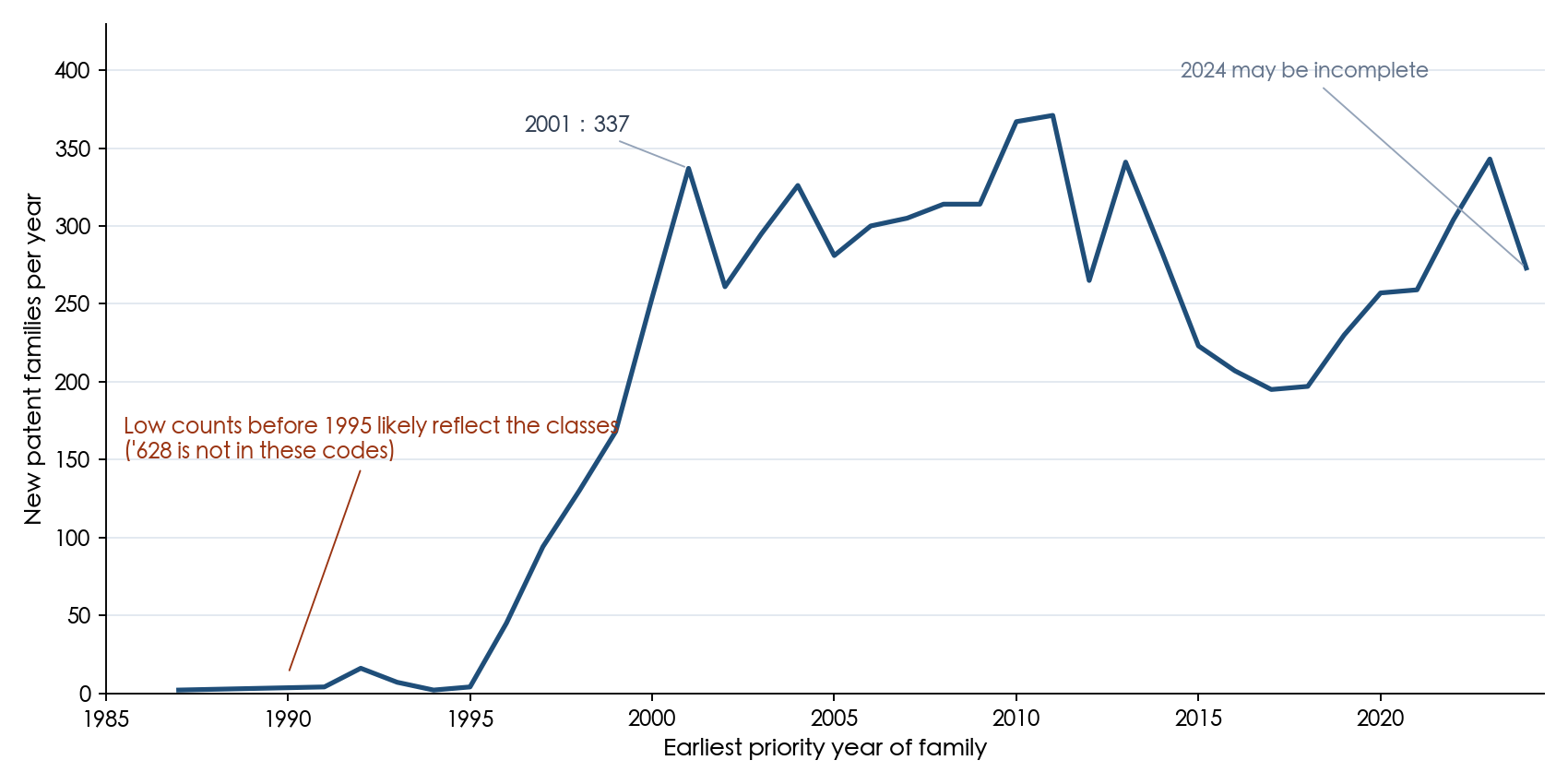
Figure: by earliest priority year of each family; 7,574 families on the chart (7,643 in the dataset; those before 1985, from 2025 on, and without a year are not drawn) 〔S90〕. The subject is patent activity, not the market and not who won. 2024 may still be incompletely published.
This chart cannot see where this story starts. The '628 family is not tagged with these specific codes; it sits only in the parent, G03F7/039 〔S01〕〔S90〕. So the low counts before 1995 cannot be read as nobody filing; that is more likely a limit of the classification (our interpretation).
New families per year reached 337 in 2001 and a charted high of 371 in 2011; from 2000 on, most years fall between 200 and 370 〔S90〕.
Applicant table.
| Period | Families | Top four (one company's earlier and later names merged) | IBM |
|---|---|---|---|
| 1995–99 | 441 | Hyundai/Hynix 60, Fuji Photo/Fujifilm 57, Samsung Electronics 35, JSR 27 | 15 |
| 2000–04 | 1,473 | Fuji Photo/Fujifilm 178, Tokyo Ohka 160, Shin-Etsu Chemical 132, Hyundai/Hynix 110 | 45 |
| 2005–09 | 1,514 | Fuji Photo/Fujifilm 227, Tokyo Ohka 194, Shin-Etsu Chemical 148, JSR 126 | 38 |
| 2010–14 | 1,627 | Fujifilm 361, Shin-Etsu Chemical 200, JSR 147, Tokyo Ohka 146 | 21 |
| 2015–19 | 1,052 | Shin-Etsu Chemical 188, Tokyo Ohka 140, Fujifilm 139, JSR 64 | 7 |
| 2020–24 | 1,436 | Shin-Etsu Chemical 332, Tokyo Ohka 165, Fujifilm 131, JSR 121 | 6 |
We merged names by matching common predecessor and successor names; a family can belong to more than one company. IBM, which wrote '628, does not rank near the top in this class. But this is filing volume, not who won, and counts are not value. Whatever is kept secret never appears in this table.
The market layer. We did not find a resist revenue series that could be compared year by year; we have only the estimates at the time points above, so this article has no market chart.
Closing: if you have a technical question of your own
The questions in this article can be reused: what could be seen at the time, what should have been asked, and which signposts were worth watching.
If you want Patti Insight to look at your own topic, there are two routes. Ready-made reports are on topics we chose, and you can buy them directly. A tailored study starts with an application: a person reviews your identity and topic first, we send a payment link only if the application is accepted, and research starts after payment. A topic may be declined, and a report may not answer everything you wanted to know. Where Patti hasn't read the full text, it won't judge whether a technical gap (something no one has solved yet) exists there.
This article did not investigate the classification you work in.
How Patti Insight works, and its limits: https://patti.empryon.ai/methods
Act 3 of this article is a simulation: rebuilt by hand by the author from public information. It is not an actual document of the time, and not output from an actual Patti run. All signposts are ours. This article is not investment advice and does not discuss share price or market value.
Ready-made reports
This article is a retrospective. For current technical questions, see the ready-made Patti Insight reports.
Source codes
Each code 〔S##〕 in the text corresponds to a line below. Every code used in this article is listed.
- 〔S01〕Ito, Willson, Fréchet | US 4,491,628 (IBM) | https://patents.google.com/patent/US4491628A/en | Primary source (patent)
- 〔S02〕Same inventors | EP 0 102 450 B1 | https://patents.google.com/patent/EP0102450B1/en | Primary source (patent)
- 〔S03〕Same | JPS5945439A | https://patents.google.com/patent/JPS5945439A/en | Primary source (patent bibliography)
- 〔S04〕George H. Smith, James A. Bonham | US 3,779,778 (3M) | https://patents.google.com/patent/US3779778A/en | Primary source (patent)
- 〔S05〕Gerhard Buhr, Hans Ruckert | US 4,311,782 (Hoechst) | https://patents.google.com/patent/US4311782A/en | Primary source (patent)
- 〔S06〕Breyta, Knors, Ito, Sooriyakumaran | US 5,492,793 (IBM) | https://patents.google.com/patent/US5492793A/en | Primary source (patent)
- 〔S08〕Houlihan, Nalamasu, Reichmanis, Wallow | US 5,843,624 (Lucent) | https://patents.google.com/patent/US5843624A/en | Primary source (patent)
- 〔S10〕US 4,350,755 "Auger microlithography" (individual applicant) | https://patents.google.com/patent/US4350755A/en | Primary source (patent)
- 〔S20〕Hiroshi Ito | "Chemical Amplification Resists: Laboratory Curiosity to Paradigm" | J. Photopolym. Sci. Technol. 20(3), 319–332 (2007) | Participant account
- 〔S26〕Thackeray, Fedynyshyn, Small | "The development of DUV chemically amplified resists" (1993, Shipley) | https://www.osti.gov/biblio/141838 | Primary source (abstract)
- 〔S27〕Willson group publications list, 1990–91 | https://willson.cm.utexas.edu/Library/Files/1990-91.htm | Citations only
- 〔S30〕David C. Brock | "Patterning the World: The Rise of Chemically Amplified Photoresists" | Distillations, Science History Institute (2007) | Scholarly secondary
- 〔S31〕UT Cockrell School | C. Grant Willson Wins Japan Prize (2013) | https://cockrell.utexas.edu/?p=23026 | University news
- 〔S40〕Semiconductor History Museum of Japan | Chemical amplification photoresist | https://www.shmj.or.jp/english/pdf/em/exhibi2462E.pdf | Scholarly secondary
- 〔S41〕SHMJ | Positive Photoresist | https://www.shmj.or.jp/english/pdf/em/exhibi2437E.pdf | Scholarly secondary
- 〔S43〕SHMJ | Shorter wavelengths of exposing sources | https://www.shmj.or.jp/english/pdf/process/exhibi412E.pdf | Scholarly secondary
- 〔S45〕Masaya Asano | Empirical study of product development in advanced materials industries (in Japanese) | Annual Report of the Society for Industrial Studies 24 (2009) | Scholarly secondary
- 〔S50〕"Industry gambles on electron synchrotrons for x-ray lithography" | Physics Today 44(10) (1991) | Trade journal
- 〔S51〕Tech Monitor | Oxford Instruments synchrotron report (August 4, 1994) | General media
- 〔S55〕Solid State Technology | Rohm and Haas, JSR settle patent litigations (August 17, 2005) | General media
- 〔S70〕Ito, Willson, Fréchet et al., 1982–84 papers (Polym. Eng. Sci. 23; ACS Symp. Ser. 242) | Not checked: citations only
- 〔S71〕SPIE 537 (1985), "The Time Has Come For X-Ray Lithography"; "X-Ray Lithography: Can It Be Justified?" | Not checked: titles only
- 〔S90〕Google Patents Public Data (BigQuery public dataset
patents-public-data.patents.publications) | queried November 3, 2026 | Primary source (patent bibliographic dataset) - 〔S91〕Willson group publications lists, 1980–89 | https://willson.cm.utexas.edu/Library/Files/1982-83.htm and adjacent pages | Citations only