If Patti Had Existed Back Then: Did Willis Carrier Invent Air Conditioning?
Patti Insight, Legends series. We take a piece of technology history everyone thinks they know and rebuild it as a Patti report: what could be seen at the time, what question should have been asked, and which signposts were worth watching (signals that a road is starting to open). We already know how the story ends, so every section says plainly what was visible at the time and what is hindsight.
Each bracketed code such as 〔S01〕 corresponds to the "Source codes" appendix at the end. The verification status of the main factual sentences is kept in a separate record, available from the publisher on request.
Three things we found, up front.
First, Carrier the company's history page titled "Invention of Air Conditioning" lists US 808,897 〔S11〕, but the patent's claims ask for a separator plate in a spray air washer. A claim is what the applicant asks to protect. Claim 1 opens with "In an air-purifying apparatus"; claims 2–4 add means for moistening the air 〔S01〕. The specification says coils can raise or lower air temperature but "constitute no separate part of the invention," and its aim is to separate impurities "either with or without altering its temperature and humidity" 〔S01〕. Bernard Nagengast, a historian writing in the ASHRAE Journal, says the machine "could control the absolute humidity" 〔S05〕. What the machine could do is wider than what the claims ask for; in our view, calling this an "air-conditioning patent" blends the two.
Second, Carrier was neither the first nor the only one working on air conditioning. Nagengast is blunt about Carrier: "he did not invent air conditioning nor was he the first to take a scientific approach to it"; but Nagengast sees Carrier's great contribution as his ability "to see that air conditioning could be an industry" 〔S05〕. Alfred Wolff's system for the New York Stock Exchange was designed in 1901, before Carrier's 1902 system for a printing plant 〔S05〕, and a 1905 report called it the largest of its class 〔S09〕.
Third, home air conditioning began as a luxury, and the machines were large; regulation was an obstacle too. According to an ASHRAE Journal history of home air conditioning, a 1930 American home had branch circuits limited to 15 amperes, the electrical code held motor appliances to 50% of a branch circuit's rating (many owners simply broke the rule), and refrigerant charge had a safety ceiling 〔S08〕. For now, this point rests on that one source.
None of these three points says Carrier doesn't matter. He left a company and a way of calculating. This history is simply more interesting than "one man invented air conditioning in 1902."
Act 1 — The version you've heard
You've probably heard this story: in 1902, Willis Carrier invented modern air conditioning at a Brooklyn printing plant, patented it in 1906, and so began today's HVAC industry. We asked a general-purpose AI to write this history (the "AI-generated version" below; it wrote in Chinese, and quotations are our translations), and it did a polished job. It called this the "modern air-conditioning system invented in 1902 and patented in 1906," the foundation of a global industry, with heat pumps, cold chains, semiconductor cleanrooms and data-center liquid cooling as extensions, and related companies with "total market value of over several hundred billion dollars."
It reads well. The trouble is that a reader can't tell which of those sentences will hold up.
What's wrong with that version
We checked the AI-generated version line by line against the sources we could read; the full table is available from the publisher on request. Six highlights:
| The AI-generated version says | Verdict | What we found |
|---|---|---|
| Modern air conditioning invented in 1902 | Disputed | That is Carrier the company's own account 〔S11〕. Nagengast, citing Cornell archives, writes that the system did not work as well as expected and was later removed; a letter at the time from Lyle, at the seller Buffalo Forge's New York sales office, reported "excellent results," and we could not settle the conflict 〔S05〕〔S06〕〔S13〕. Carrier himself placed "the first real air-conditioning installations" in 1906 〔S06〕. |
| This 1902 system was patented in 1906 | Needs correction | US 808,897, filed in 1904 and issued in 1906, is a different design: spray-type, not the cooling coils of 1902 〔S01〕〔S05〕. |
| The centrifugal chiller is a "direct extension" of this patent | Needs correction | The patent is about spray and separator plates 〔S01〕; the centrifugal chiller is a separate set of Carrier patents, with a compressor chosen from the C. H. Jaeger Company of Leipzig and then adapted, and a refrigerant, dielene (dichloroethylene), that German chemists had developed as a cleaning fluid (company account) 〔S10〕. |
| Heat pumps are also a "direct extension" | Wrong | Heat-pump theory and machines predate this patent (general media) 〔S27〕, and the claims contain no refrigerant cycle 〔S01〕. Carrier's 2024 purchase of Viessmann's climate business is a matter of ownership, not a patent extension 〔S20〕. |
| Cold chains and cleanrooms are extensions | No primary source found | The society wiki ETHW credits automatic refrigeration for long-haul trucks to Frederick Jones, on a page that doesn't mention Carrier 〔S33〕; Sandia National Laboratories' news release credits the modern cleanroom to Whitfield and doesn't mention Carrier either 〔S31〕. |
| Related companies worth "several hundred billion dollars" | Attribution that can't be verified | This credits the market value of several companies' entire businesses to one patent. Those companies do many other things, and their valuations move daily. We don't do this kind of sum. |
The point isn't that the AI is bad. The AI-generated version gets Carrier's 2020 spin-off from United Technologies (UTC) 〔S19〕 and the Viessmann purchase 〔S20〕 right. The trouble lies mostly in causation: more than a century of work by many people gets drawn as one straight line from one person. A reader has no way to tell which segments have evidence.
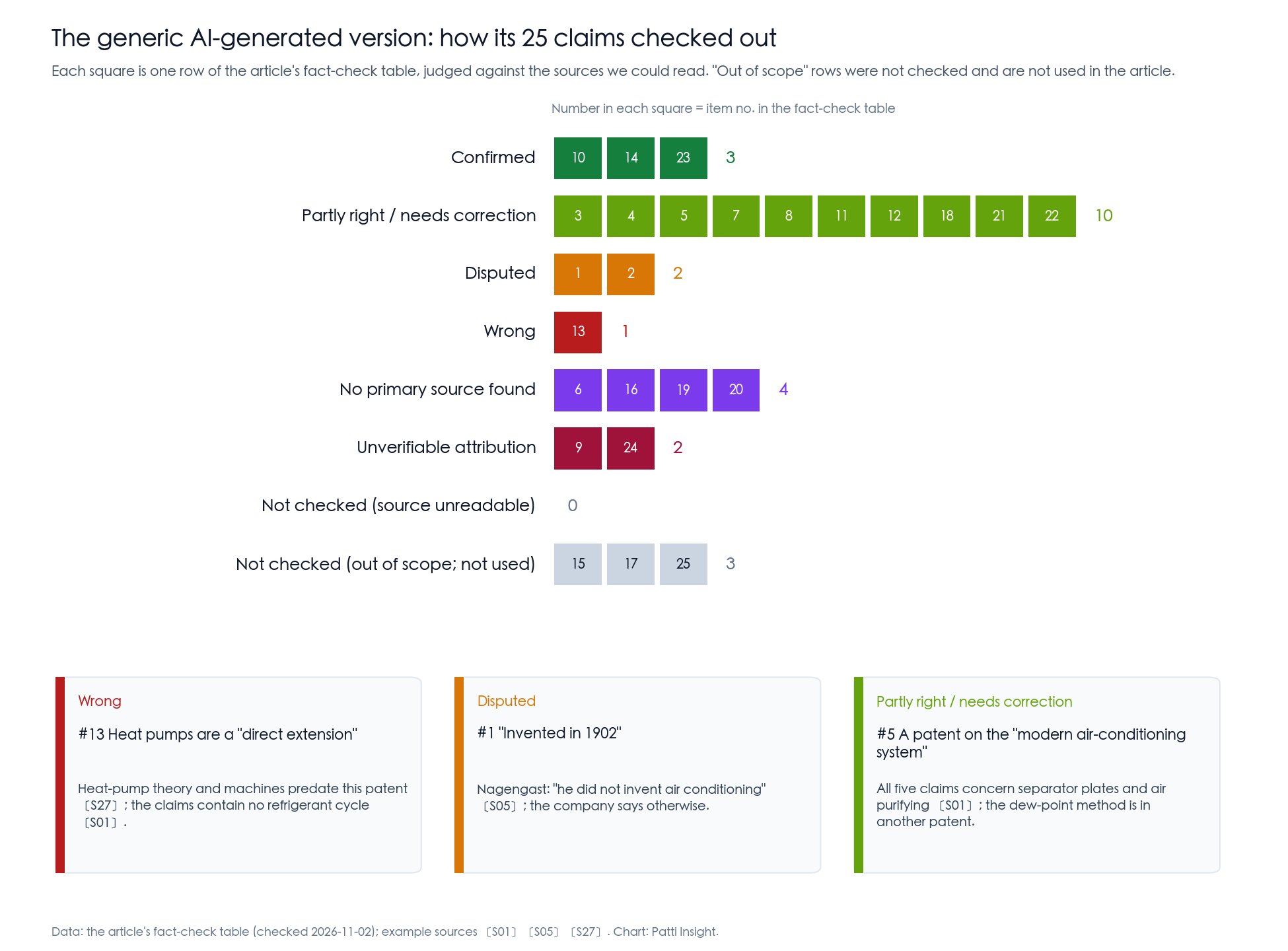
Figure: The 25 rows of the fact-check table, grouped by verdict. Confirmed 3; partly right or needing correction 10; disputed 2; wrong 1; no primary source found 4; unverifiable attribution 2; not checked because the source could not be read 0; a further 3 are out of scope, unchecked and not in the text. Sources for the three examples: 〔S01〕〔S05〕〔S27〕.
Act 2 — How someone back then would have asked
Set the clock to the end of 1906. Suppose you run engineering at a mid-sized American fan and sheet-metal maker. Textile mills and printers have started asking about humidity, and an engineering weekly has reported on the Stock Exchange's cooling plant. Your CEO asks: should we get in?
Most people would ask it like this:
The typical question: "What are the development trends in air conditioning?"
That gets you an encyclopedia entry: which methods exist, how each works, which looks promising. You still don't know whether to invest.
If Patti had been available in 1906, it would first restate your question back to you, and ask it like this instead:
The question after Patti's restatement: "We are a mid-sized maker of fans and sheet-metal ducts in the U.S. (say where you sit). We need to decide whether to commit to air-treatment equipment over the next five years (say what decision you're making). To control indoor temperature and humidity, what are the routes, and what limit is each stuck on (ask about the bottleneck, not the trend)? What signals would show that a route is starting to work (ask for signposts, not predictions)? Use only information public by the end of 1906."
(Illustration. The actual restatement screen keeps your original question word for word, then lists the aspects Patti suggests adding for you to tick.)
Four things change: where you sit, the decision, the bottleneck, the signposts. A fan maker cares about one thing: which route needs what I make?
If Patti had existed back then ①: ask differently, get a different report
The typical question Asked the Patti way What it asks about Trends Bottlenecks and signposts The report you get An encyclopedia entry: methods, how each works, which looks promising A signpost table: where each route is stuck, and which signals mean it is working What you can do after reading Still not sure whether to invest Know which signals to ask about; Act 4 reviews how well they were written For you, the fan maker Thermodynamics that has nothing to do with you Which route needs what you make Act 3 is the report you get when you ask the Patti way.
Act 3 — The 1906 Patti report (data cutoff: end of 1906)
The following was rebuilt by hand by the authors along these lines; it is not output from a real Patti run. The data keeps to the cutoff, but which documents we picked and which signposts we set are shaped by hindsight.
Everything below uses only information public or observable by the end of 1906, some of it read through later histories. A patent's "issue" date is when the office made it public; its "filing" date is when it was submitted. A one-page version appears as the figure at the end of this act.
The problem. Factories and buildings want to control two things, temperature and humidity, and humidity is often harder: ventilation alone can't bring moisture below the outdoor level (our judgment). Cooling with ice had been tried: a report in 1880 covered the Madison Square theater, and a system Alfred Wolff designed for Carnegie Music Hall in 1889 "was not engineered to maintain a specified temperature and humidity," with no confirmation that it was used 〔S07〕.
The bottleneck. Public information shows three main routes, each stuck on its own limit as described under each route, plus side branches such as desiccants that we don't develop here.
Route 1: Spraying water to humidify (textile mills). By the 1890s, fan systems "were also being equipped with air washers for filtering and humidifying" 〔S05〕. In May 1906 the textile man Stuart Cramer read a paper, "Recent Developments in Air Conditioning," covering humidifying and evaporative cooling 〔S05〕〔S24〕. In the 19th century, cold water or evaporative cooling "placed a limit on the amount of comfort" 〔S05〕; bringing moisture below the outdoor level looks hard on this road (our judgment). - Signpost ① (set by the authors): A public demonstration of bringing indoor humidity below the outdoor level without a refrigerating machine; time limit five years.
Route 2: Mechanical refrigeration with cooling coils (buildings). Germany's Rietschel had a chapter on room cooling in his 1894 textbook 〔S05〕. A 1905 engineering weekly reported that Alfred Wolff's system for the New York Stock Exchange used ammonia absorption machines of 450 tons' refrigerating capacity, calling it the largest of its class, with indoor temperature 10–14°F below outdoors and humidity averaging 55% 〔S09〕. This route's price is scale and machinery: a huge system, running on ammonia (our judgment). - Signpost ② (set by the authors): A refrigerating machine on public sale that is compact and doesn't use ammonia; time limit ten years.
Route 3: The spray air washer. Carrier's US 808,897, "Apparatus for treating air," was filed on September 16, 1904, issued on January 2, 1906, and assigned to Buffalo Forge 〔S01〕. Claim 1 asks for the separator in an "air-purifying apparatus": upright plates forming sinuous passages that promote separating liquid from air 〔S01〕. The patent's stated aim is to separate solid impurities "either with or without altering its temperature and humidity"; its nozzles are "of a well-known type"; and the coils for raising or lowering air temperature "constitute no separate part of the invention" 〔S01〕. Buffalo Forge began making these washers in 1905 〔S05〕. With water cold enough, a washer can also dehumidify; Rietschel had already said so (per Nagengast) 〔S05〕. The bottleneck is control: how to calculate in advance how much water, and how cold (our judgment, with a touch of hindsight). And the patent belongs to Buffalo Forge, which is already making these; you would be a latecomer (our judgment). - Signpost ③ (set by the authors): A public, calculable method that lets a maker work out temperature and humidity in advance; time limit five years.
What it means for you. All three routes move air, so your fans and ducts apply; the difference is customers and competition: Route 1's customers are textile mills, Route 2's are large buildings, and Buffalo Forge is already on Route 3 (our judgment). Where you sit decides which signpost you should be watching.
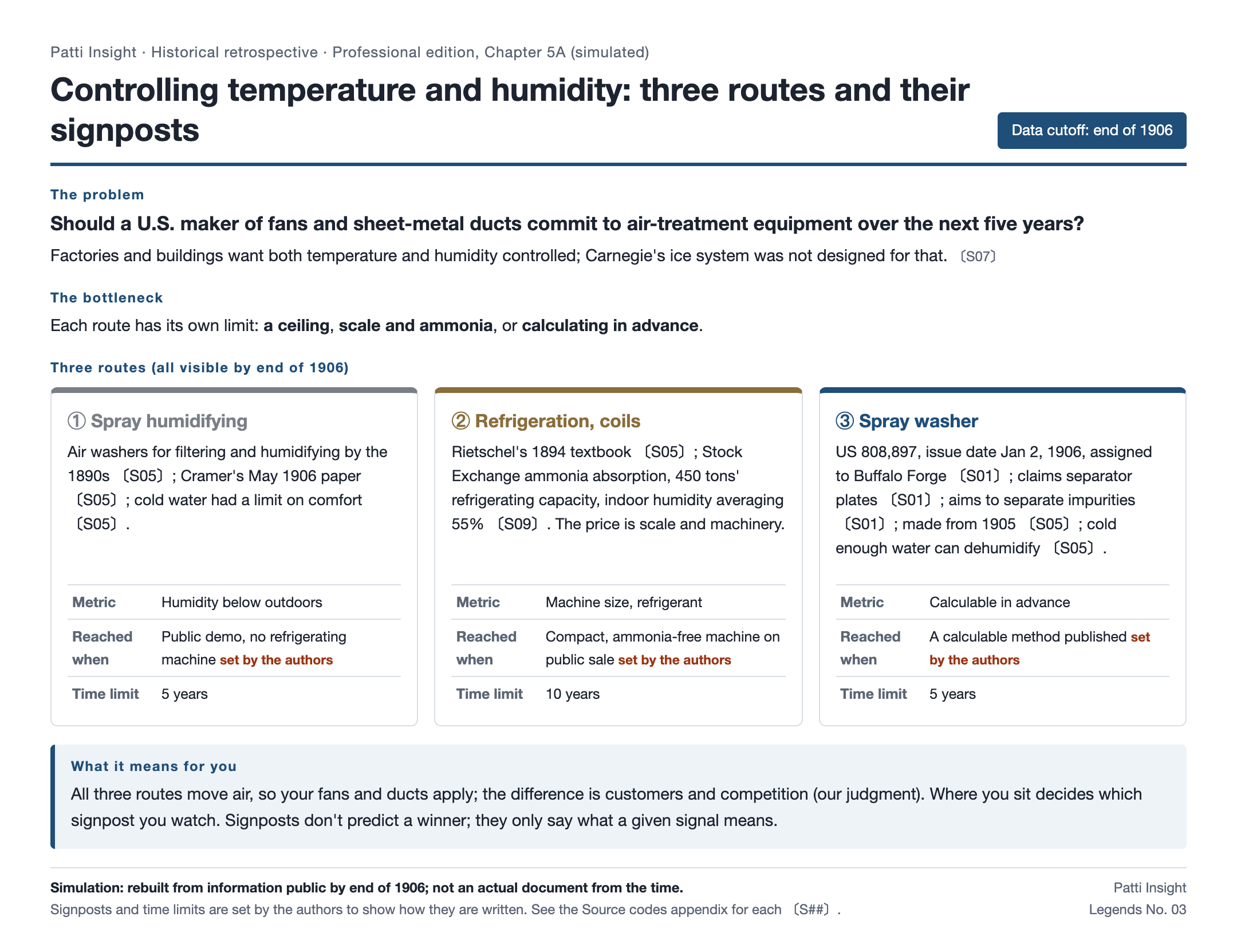
Figure: The one-page version of Act 3, rebuilt only from information public by the end of 1906 〔S01〕〔S05〕〔S07〕〔S09〕. It is a simulation, not an actual document from the time; signposts and time limits are our own.
If Patti had existed back then ②: are these three signposts enough to decide?
At the end of 1906, these three signposts are what you hold (the one-page version is above), and your decision covers the next five years. Would seeing them change your decision? And is anything missing from them? Think it over, then turn to Act 4.
Act 4 — The reveal (hindsight)
Everything in this section was learned after the fact. A 1906 reader couldn't see it.
How did the three signposts do? Honestly, we wrote them badly. Within five years, signpost ① was not seen; ② has a ten-year limit and can't be judged anyway; ③ was already true before the starting point, the end of 1906.
| Signpost (set by the authors) | Time limit | What we read | Result |
|---|---|---|---|
| ① Humidity below outdoors without a refrigerating machine | 1911 | We read of no qualifying public demonstration | Not seen |
| ② A compact, ammonia-free refrigerating machine on public sale | 1916 | The Congress Hotel had a carbon-dioxide machine in 1907 〔S05〕; Carrier's centrifugal chiller was demonstrated in 1922, with a first customer in 1923 (company account) 〔S10〕 | Can't be judged: "compact" was never defined |
| ③ A calculable method published | 1911 | Carrier published "Rational psychrometric formulae" in 1911 〔S05〕; but Rietschel had given formulas in 1894, the Stock Exchange report calculated its tonnage, and Carrier may have published a humidity chart by 1906 〔S05〕〔S06〕〔S09〕 | True before the start, so it tells you nothing |
So these three signposts can't support a decision to invest or not: none covers demand or profit, and the only one reached, ③, was already true at the start. We leave it here because that is a lesson too: a signpost should first ask, "If I see this, would my decision change?"
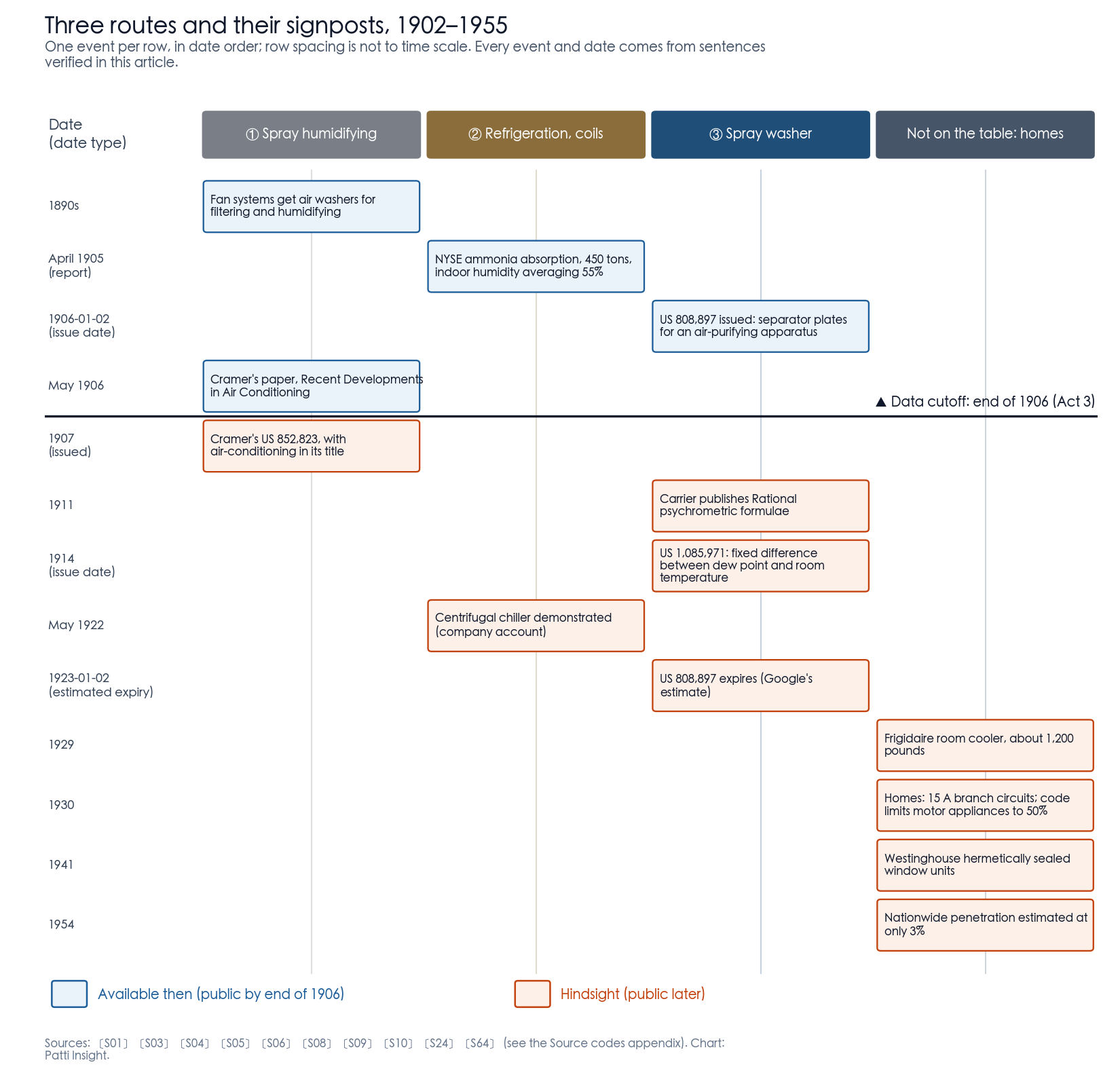
Figure: Key events on the three routes and in the home market, in date order; row spacing is not to time scale. Blue boxes were public by the end of 1906; orange boxes are hindsight. The bracket after each date gives its type; where the original source does not say, we leave it off 〔S01〕〔S03〕〔S04〕〔S05〕〔S08〕〔S09〕〔S10〕.
What happened at the 1902 printing plant. Sackett & Wilhelms was a Brooklyn color printer, and its problem was humidity: the system was to hold 80°F and 55% relative humidity in summer, using well water alone at first, with the refrigerating plant not installed until 1903 〔S05〕〔S06〕. This is a story of factory humidity control, not of comfort. Tests in September 1904 showed relative humidity falling from 86% to 63%, short of 55% 〔S06〕. Carrier the company's own history adds that in 1952 it supplied the air-conditioning system for the first nuclear-powered submarine, USS Nautilus (SSN-571); this is a company account we could not confirm independently, and Willis Carrier himself had died in 1950 〔S67〕.
One turn was using water to remove moisture. Carrier later recalled the idea as a paradox: "reducing the moisture in the air by bringing it into contact with moisture," spraying water colder than the dew point 〔S05〕. A machine sold to the Chronicle Cotton Mill in 1906 "did not work as well as Carrier had hoped," and Nagengast writes that Carrier worked out the control relationships after that 〔S05〕; a method keeping a fixed difference between supply-air dew point and room temperature is in US 1,085,971, filed in 1907 and issued in 1914 〔S03〕, while Nagengast points to US 854,270 for dew-point control 〔S05〕. In 1906 Cramer also used "air-conditioning" in a patent title, filed that April and issued in 1907 〔S04〕〔S05〕.
Then came a company and a method. Buffalo Forge set up an air-conditioning subsidiary in 1907; by the company's account, in 1915 Carrier and six others founded Carrier Engineering Corporation 〔S05〕〔S11〕. Carrier's humidity chart (a lookup chart relating air temperature and humidity) and the 1911 paper "Rational psychrometric formulae" (which we did not read) came out of his work on calculation; Nagengast's two articles differ on the chart's date: his 2002 article says it appeared in a catalog by 1906 〔S06〕, while his 1999 article says development began around 1907, and mentions manuscripts dated 1908 that once existed 〔S05〕. That is where Nagengast's assessment lands: Carrier saw that this could be an industry 〔S05〕.
Theaters came before the centrifugal chiller. In 1922, Carrier's own firm designed the system for the Metropolitan Theater in Los Angeles, still using a carbon-dioxide machine; with downward air delivery, bypass and automatic control, Nagengast says it "proved that theater air conditioning was a workable idea" 〔S05〕. According to the ASHRAE Journal, theaters could "recover the cost of their air-conditioning equipment in just one summer" 〔S08〕. By the company's account, a 1920 internal memo required a refrigerant that was non-toxic and non-flammable, and the centrifugal chiller, demonstrated in May 1922, offered a safer, more compact option; it reached theaters at the Rivoli in 1925 〔S10〕. Freon (the trade name for a family of chlorofluorocarbon refrigerants, or CFCs) wasn't Carrier's; it came from Midgley's team at General Motors 〔S29〕〔S30〕.
What the signposts didn't list: the door into the home. The signposts in Act 3 are entirely technical and never mention homes. Home units began as a luxury, and the machines were large. Beyond that, from Pauken's history of home air conditioning 〔S08〕: - Electricity: "The typical home in 1930 had only a 30-ampere capacity with a 15-ampere limit on each two-wire branch circuit," and the National Electrical Code held motor appliances to 50% of a branch circuit's rating. Many owners broke the rule, and upgrading to 60 amperes later solved many problems. - Refrigerant: small compressors were otherwise suitable, but it was "virtually impossible to meet the safety code limitations on the refrigerant charge size for the home."
In the 1920s and early 1930s nearly all air-conditioning condensers were water-cooled, needing water and sewer connections at extra cost to the homeowner; the water-supply figure comes from downtown commercial systems: an estimate for 1948 was that water-cooled air conditioning in central Chicago "could have consumed well over half of the peak water consumption" 〔S08〕.
Frigidaire introduced its first room cooler in 1929, and De La Vergne's 1931 air-cooled console, though classed as portable, weighed about 1,200 pounds and was never moved from room to room; Thorne's 1932 window unit was doubtfully mass-produced; Westinghouse sold hermetically sealed window units in 1941; for 1952 Pauken says sales approached 300,000, while U.S. census shipments were 372,000, on a different basis; an estimate for 1954 put nationwide penetration at only 3% 〔S08〕〔S64〕. And the road into homes didn't come straight from US 808,897: several companies took part, and it needed codes and housing to change too (our judgment; the home-air-conditioning history we read 〔S08〕 nowhere mentions this patent).
And US 808,897? Google Patents estimates that it expired on January 2, 1923 〔S01〕, around the time of the chiller demonstration and long before home air conditioning spread.
What we could not check. We did not read the 1911 paper itself, the 1906 catalog, the Cornell archives and Ingels's biography, non-company sources on the Rivoli theater, or original sources on electricity prices and building codes in 1920–50. The chiller and its 1922 demonstration rest mainly on the company's account, and the home-regulation section on one source. If we could read these, some judgments above might change.
Looking back at Act 3: The signposts' faults are clear: they have nothing on demand or profit, and they never imagined that homes would run into electrical codes. We don't claim anyone would have thought of that then. It's also what we most want to leave you with: apart from the technology, ask one more question: who pays, and whose rules decide whether this gets through the customer's door?
If you had Patti today ③: will yesterday's answer stay the answer?
Act 4 looks like an ending: air conditioning reached the home. But what solved a problem then isn't necessarily the answer forever. What happened next?
Interlude — When history can reverse (hindsight)
Everything in this section is hindsight.
The refrigerant road reversed twice. Early refrigerating machines used ammonia, methyl chloride and sulfur dioxide, which are toxic or flammable 〔S29〕〔S30〕; Freon, a family of CFCs, solved that. Then in 1974, Molina and Rowland published a paper pointing to CFCs' effect on the ozone layer (we did not read the original) 〔S29〕. The 1987 Montreal Protocol put CFCs under control for phase-out, with developed countries reaching zero in 1996 (with exceptions) 〔S16〕〔S17〕. Their later replacements, hydrofluorocarbons (HFCs), were in turn ordered phased down by the 2016 Kigali Amendment 〔S18〕.
Will the ammonia and carbon dioxide of the early years come back? Nagengast records a carbon-dioxide system at the Congress Hotel in 1907; his article separately carries a figure of Carrier equipment in 1917, with an ammonia compressor 〔S05〕. The caption doesn't say where this equipment stood, and the article doesn't say the Congress Hotel changed refrigerant, so they don't show one replacing the other. Whether these two refrigerants are coming back today, we have read no primary evidence: we hold only search summaries of EU regulation, vendor pieces and an EIA press release, not the originals 〔S38〕. So this is only a signpost worth watching (our inference), not a conclusion.
For engineers today: Freon solved the safety problem then, and later became what regulation set out to remove. What matters isn't being in the mainstream. It's knowing what conditions the mainstream rests on, and which of them can change.
If Carrier had had Patti in 1904 ④: where does this function turn up later?
When Carrier filed US 808,897, he could not see what came after; a chart of where a patent's function turned up later can only be drawn in hindsight. Act 5 draws one. When you've seen it, ask yourself: where will the function in your patent turn up later?
Act 5 — Descendants?
Here is the core function of this technology, written as one sentence:
Treat the air passing through with water or a refrigerant, controlling its temperature and humidity at once.
Technologies that do this are common later. Whether they descend from this patent is another matter.
What the citation data says. In Google Patents data, this patent is cited by 22 documents in 19 patent families (a family groups one invention's filings across countries) 〔S63〕. The earliest three are a louver wall box (issued 1957), a whirl spray nozzle (issued 1957) and a device for removing moisture from a gas (issued 1958); the companies named in the bibliographic data are, in order, John J. Nesbitt, Spraying Systems and Bristol Aero Engines 〔S63〕. Of the 22, 17 are labeled search-report citations, 2 applicant citations and 3 from the publication stage 〔S63〕. Before 1957, this data has no citation record; earlier citations may simply not have been captured, so the blank doesn't mean no influence (our judgment). This data therefore neither shows a straight line nor rules one out. A citation is not a lineage.
What the classification data says. Patent offices tag each patent with technical classes. This patent's main class is B01D45/08 (separating with baffles), not the air-conditioning class F24F or the refrigeration class F25B; but the old U.S. cross-reference tags it under air cooling and automatic humidity regulation (Y10S261) 〔S63〕. These classes were added later and show how others filed it, not whether it counts as an air-conditioning patent. In a sample of 10 titles from B01D45, most were about dust removal, demisting or separation, the closest being a power-plant cooling tower 〔S63〕. Carrier's US 854,270, by contrast, falls in the humidity-control class F24F3/14 〔S63〕. The chart below lays out the related technologies decade by decade by patent class.
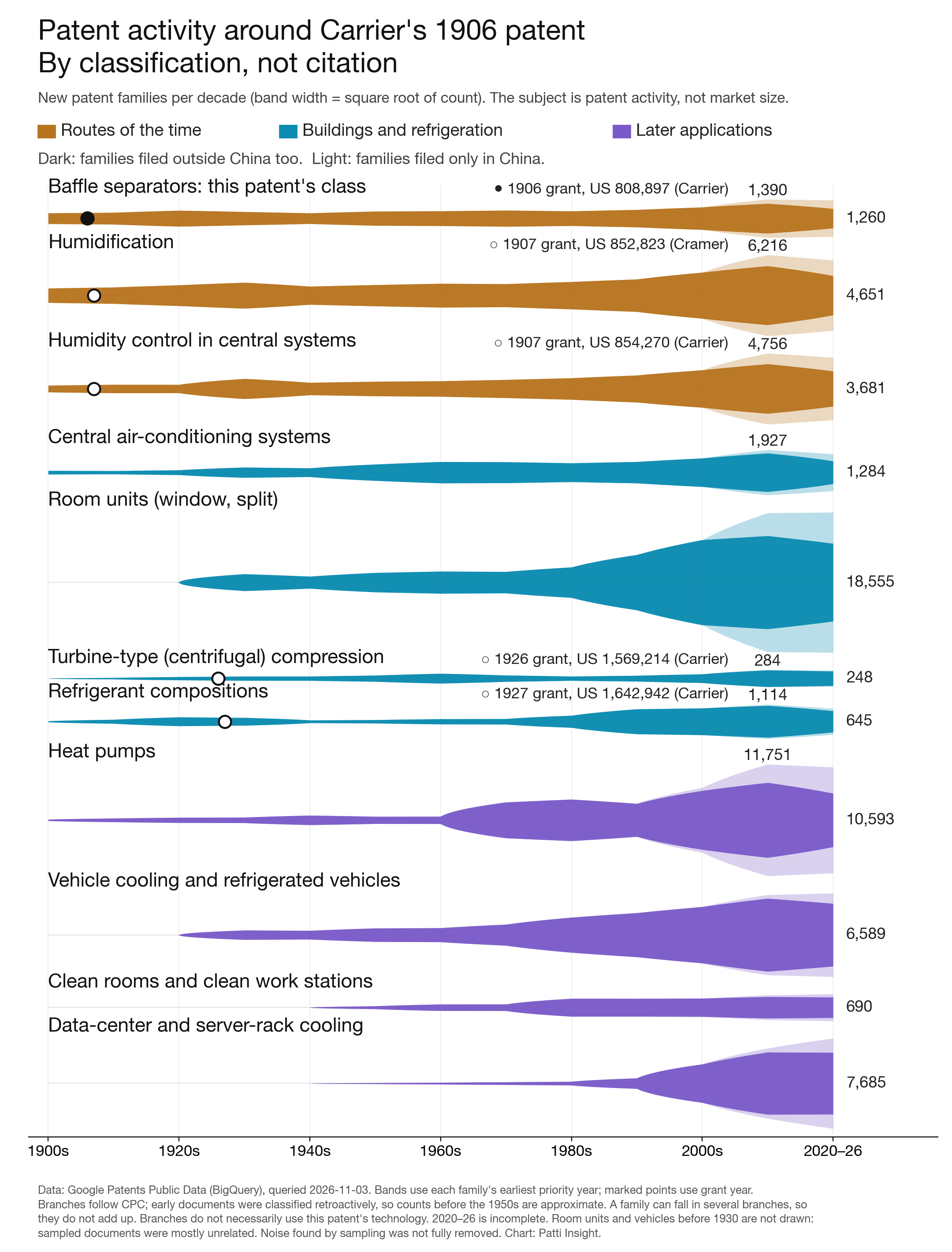
Figure: New patent families per decade; band width is the square root of the family count, binned by each family's earliest priority date 〔S63〕. Branches are assigned by patent classification — not by citation, and they are not descendants of this patent. The subject is patent activity, not market size. A family can belong to several branches, so branches can't be added up. Classifications on early documents were added retroactively, so decades before the 1950s are approximate; filings from 2020–26 are not yet fully published and cover only seven years. Not all noise has been removed.
Branch by branch.
- This patent's main class. Separating with baffles had 1,390 families in the 2010s, 553 of them filed only in China 〔S63〕. Judging from sampled titles, most of it isn't air conditioning.
- Humidity control and humidifying. Humidity control and dehumidifying had 4,756 families in the 2010s (2,434 only in China), and humidifying 6,216 (2,932 only in China) 〔S63〕.
- Centrifugal compression. Only 284 families in the 2010s; Carrier's 1921 centrifugal-chiller filings fall in another class, so this branch is undercounted (our judgment) 〔S63〕.
- Later applications. Room air conditioners had 18,229 families in the 2010s (10,039 only in China); heat pumps 11,751 (6,445 only in China); data-center cooling 4,645 (990 only in China), and 7,685 in 2020–26 (4,079 only in China) 〔S63〕. These are far larger than this patent's class, but they don't necessarily use its technology. They share the chart to show scale, not to say they all came from this patent.
The market layer: three U.S. official series that don't join into one line. The three below have different subjects, and all are U.S., not global. Room air-conditioner shipments: 194,000 units in 1950 and 5,438,000 in 1970 〔S64〕. New single-family houses with central air conditioning: 49% in 1973 and 98% in 2025 〔S65〕. Households: 68% had air conditioning in 1993; 88% used it in 2020, on a different question 〔S66〕. These figures can't tell you who deserves credit.
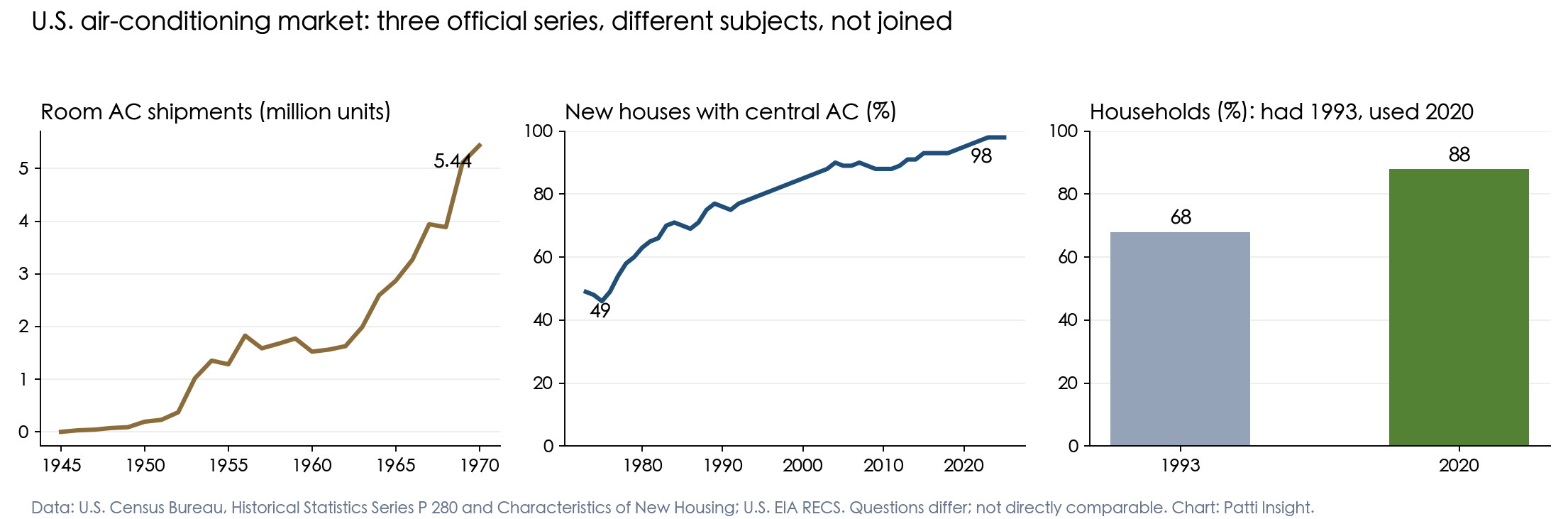
Figure: The three series measure shipments, new houses and all households, and are not joined. Data: U.S. Census Bureau, U.S. Energy Information Administration 〔S64〕〔S65〕〔S66〕. This article did not investigate global markets for any branch.
Those hundreds of billions in market value can't be credited to Carrier or to any single patent. Industries grow from more than a century of work by many people, and this one also has to do with electrical codes and refrigerant rules. Patti answers "where does this function reach?" — not "whose money is this?"
Closing: if you have a technical question of your own
The method shown in this article can be reused: what could be seen at the time, what should have been asked, and which signposts were worth watching.
If you want Patti Insight to look at your own topic, there are two routes. Ready-made reports are on topics we chose, and you can buy them directly. A tailored study starts with an application: a person reviews your identity and topic first, we send a payment link only if the application is accepted, and research starts after payment. A topic may be declined, and a report may not answer everything you wanted to know. Where Patti hasn't read the full text, it won't judge whether a technology gap (something no one has solved yet) exists there.
Which branch your technology falls in, and how that branch is doing, this article did not investigate.
How Patti Insight works, and its limits: https://patti.empryon.ai/methods
Act 3 of this article is a simulation: rebuilt by hand by the authors from information public by the end of 1906, not an actual document from the time and not output from a real Patti run. All signposts were set by the authors to illustrate the method, and to show how it can go wrong.
Ready-made reports
This article is a retrospective. For current technical questions, see the ready-made Patti Insight reports.
Source codes
Each code 〔S##〕 in the text corresponds to a line below. Every code used in this article is listed.
- 〔S01〕Willis H. Carrier | "Apparatus for treating air," US 808,897 | https://patents.google.com/patent/US808897A/en | Primary source (patent)
- 〔S03〕Willis H. Carrier | "Method of humidifying air and controlling the humidity and temperature thereof," US 1,085,971 | https://patents.google.com/patent/US1085971A/en | Primary source (patent)
- 〔S04〕Stuart W. Cramer | "Humidifying and air-conditioning apparatus," US 852,823 | https://patents.google.com/patent/US852823A/en | Primary source (patent)
- 〔S05〕Bernard Nagengast | "Early Twentieth Century Air-Conditioning Engineering" | ASHRAE Journal, March 1999 | Scholarly secondary source
- 〔S06〕Bernard Nagengast | "100 Years of Air Conditioning" | ASHRAE Journal, June 2002 | Scholarly secondary source
- 〔S07〕(Author inferred from the series as Nagengast) | "Comfort from a Block of Ice" | ASHRAE Journal, February 1999 | Scholarly secondary source
- 〔S08〕Mike Pauken | "Sleeping Soundly on Summer Nights: A History of Air Conditioning in the Home" | ASHRAE Journal, May 1999 | Scholarly secondary source
- 〔S09〕"Heating, Ventilating and Air Cooling at the New York Stock Exchange" | The Engineering Record, April 1905 series | Primary source
- 〔S10〕Carrier | Commemorating 100 Years of Willis Carrier's Invention of Centrifugal Chiller Technology | c. 2022 | Company account
- 〔S11〕Carrier | Invention of Air Conditioning | https://www.carrier.com/us/en/history/invention-of-air-conditioning/ | Company account
- 〔S13〕Carrier | 1876–1902 | https://www.williscarrier.com/1876-1902/ | Company account
- 〔S16〕UNEP Ozone Secretariat | The Montreal Protocol | https://ozone.unep.org/treaties/montreal-protocol | Primary source
- 〔S17〕UNEP | Article 2A: CFCs | https://ozone.unep.org/treaties/montreal-protocol/articles/article-2a-cfcs | Primary source
- 〔S18〕UNEP | Kigali Amendment (2016) | https://ozone.unep.org/treaties/montreal-protocol/amendments/kigali-amendment-2016-amendment-montreal-protocol-agreed | Primary source
- 〔S19〕Carrier Global | News release (8-K Ex. 99.1) | April 3, 2020 | Primary source (statutory filing)
- 〔S20〕Carrier | "Carrier Completes Acquisition of Viessmann Climate Solutions" | January 2, 2024 | Company account
- 〔S24〕NC State University | Stuart W. Cramer | https://history.textiles.ncsu.edu/textile-people/stuart-w-cramer | General media (university history)
- 〔S27〕Wikipedia | Heat pump | https://en.wikipedia.org/wiki/Heat_pump | General media
- 〔S29〕Mark Bernstein | "Freon" | Invention & Technology 25(3), 2010 | https://www.inventionandtech.com/content/freon | General media
- 〔S30〕NOAA GML educational handout | The Chlorofluorocarbons | https://gml.noaa.gov/outreach/info_activities/pdfs/TBI_the_chlorofluorocarbons.pdf | General media
- 〔S31〕Sandia National Laboratories | "Modern-day cleanroom invented by Sandia physicist still used 50 years later" | 2012 | https://newsreleases.sandia.gov/cleanroom_50th/ | Institutional news release
- 〔S33〕ETHW | Frederick McKinley Jones | https://ethw.org/Frederick_McKinley_Jones | General media (society wiki)
- 〔S38〕EU F-gas Regulation 2024/573 and vendor pieces on natural refrigerants; EIA press release | https://eia-international.org/press-releases/natural-refrigerant-heat-pumps-are-no-longer-a-future-promise-theyre-here/ | Search summaries only; originals not read
- 〔S63〕Google Patents Public Data (BigQuery public dataset
patents-public-data.patents.publications) | Queried November 3, 2026 | Primary source (patent bibliographic dataset) - 〔S64〕U.S. Bureau of the Census | Historical Statistics of the United States, Colonial Times to 1970, Part 2, Series P 280 | https://www2.census.gov/library/publications/1975/compendia/hist_stats_colonial-1970/hist_stats_colonial-1970p2-chP.pdf | Primary source (government statistics)
- 〔S65〕U.S. Census Bureau | Characteristics of New Housing: Presence of Air-Conditioning in New Single-Family Houses Completed | https://www.census.gov/construction/chars/xls/aircond_cust.xls | Primary source (government statistics)
- 〔S66〕U.S. Energy Information Administration | Today in Energy, August 19, 2011 and May 31, 2022 | RECS surveys | Primary source (government statistics)
- 〔S67〕Carrier | Marine & Offshore History | https://www.carrier.com/marine-offshore/en/worldwide/about/marine-offshore-history/ | Company account (retrieved 2026-11-21)